
Time to hit the books
The secret to a good occult career


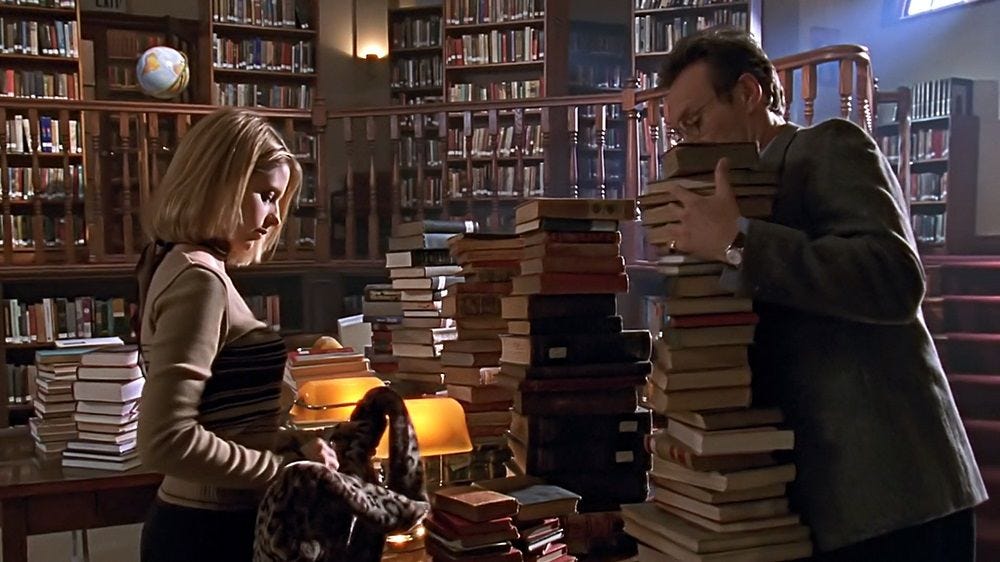
I was recently chatting with a friend about a book, who told me he would just read the AI summary. How could I explain it to him?
I travelled 20,000 leagues under the sea with Ned Land and Pierre Aronnax in Captain Nemo’s submarine. I later found the captain on a mysterious island where the balloon that had carried us, along with the engineer Smith, Harbert and others, had crashed. I took revenge on Danglars, Mondego and Villefort for imprisoning me in the Château d’If for years, from which I escaped only to end up on the island of Monte Cristo. I was present during Cyrus the Great’s conquest of Elam. A few years ago, with little money in my pocket, I embarked on a whaling ship that was sunk by a captain obsessed with revenge against a white sperm whale. I had a romance in Santiago at the end of the 19th century, during the Balmacedist revolution.
Even harder to explain are those adventures through Middle-earth, accompanying a hobbit, being constantly watched by Big Brother in Australia, and all those mysteries I watched Poirot, the world’s greatest detective, solve with such skill until the final “curtain” fell. Nor can I explain, because a summary will not allow it, how wine becomes sweeter when you read Khayyam’s quatrains and how desolation takes on meaning when you read Rumi. I will not even try to justify why I like Huidobro’s poems, among the most underrated in my country, or why Emily Dickinson and William B. Yeats make me tearful. None of that fits into a summary an AI could write.
Reading is more than just loading words into our brains; it’s sharing a vital experience. It connects us with the person who wrote that book and with other readers, others who were Aronnax or Dantès or Rivas, people who said “Call me Ishmael,” people who sent their soul through the seventh gate of Saturn’s throne and laid their dreams at the feet of another, people who were strong and then weak, people to whom God said to keep the pain in their hearts because through it the light entered. When you read a novel or poem, you share an alternate reality with all those who read it.
The fragility of education across western culture, dressed as an improvement that claims to respect diverse interests, often amounts in practice to loosening standards so institutions do not lose state subsidies. Children and adolescents are asked to read fewer books and less is expected of their comprehension. As a result, some adults in their 20s, scarcely read at all, and this has less to do with intellectual ability than with the absence of any reading habit. In a bitter twist, the wish to educate better has produced an education that grows steadily weaker.
Let us not judge the younger generation too harshly, because in our own there are plenty who are no lovers of books unless a fashionable novel happens to be in vogue. Fools appear in every generation, and the only difference is that in ours they seemed to arrive fully formed, while current ones are raised that way.
In magic, the matter carries more weight than it first appears. Magical texts, especially the classics, resist summary and demand careful reading and sustained analysis. A text of 20 pages can take months to study, as you set it within its historical, social, religious and linguistic frame, and then within its magical one. Anyone unused to extended reading is poorly equipped for serious practice, because there is always more to read and think through.
That may help to explain why we now face what could be the most mediocre generation of practitioners, if that description is not too generous. Some believe that repeating a number in their mind will erase their karma, others think they can bypass years of astrological study and still perform a ritual grounded in astrology, others treat karma and dharma as opposites, and some are convinced that the Kybalion contains all they need to know.
Reading does more than just transmit information; it strengthens neural plasticity, helping us concentrate on an unfolding narrative much like watching a long film sequence. As you immerse yourself, your attention shifts from the individual words to the evolving story, with the words blending into the experience. Cultivating imagination is essential, and frequent readers tend to find this easier than those who rarely pick up a book.
Imagination sets the boundaries for magic; only outcomes that can be vividly pictured and believed are possible. If someone can’t imagine a result, magic cannot achieve it, so limited imagination restricts magical potential.
Path working, as described in books by Dolores Ashcroft-Nowicki, Melita Denning, or Nick Farrell, is challenging if you cannot simultaneously read and visualise, since forming a mental image is necessary before using these techniques.
There is another aspect to consider that concerns magic directly, and it has to do with discipline. Reading a demanding book is an act of sustained attention, which is the foundation of any serious magical operation. When you sit with a difficult text and refuse to skim it, you are training the same faculty that must hold a visualisation steady during a ritual, maintain intention without drifting, or return to a symbol repeatedly until it opens.
Magic relies on symbols and correspondences, meanings are layered, and this cannot be sustained by vague or superficial desire. Deep reading reveals recurring patterns across cultures and eras, showing connections between myths and ideas. This understanding forms an internal guide and without it, ritual is just performance.
Many esoteric traditions require students to spend extensive time studying before they engage in serious practice. This approach isn’t about elitism but a necessary form of preparation. If someone’s mind cannot grasp a complex argument over thirty pages, they’ll likely struggle with rituals that progress through stages like invocation and transformation. Likewise, someone who hasn’t navigated ambiguous literature may lack patience for the ambiguity often present in authentic inner experiences.
By reading challenging literature and intricate esoteric texts, individuals encounter contradictions and unanswered questions, learning to accept situations without immediate resolution. Such tolerance is crucial in magical practices, which rarely yield instant results and can take months or years for personal change to fully solidify. Our culture’s emphasis on quick answers erodes this patience, leading practitioners to expect mystical processes to be as swift and predictable as using a search engine.
Additionally, when you read a great novel or poem, you temporarily inhabit another consciousness, you see the world through a different moral framework and emotional structure. This flexibility of perspective expands empathy and psychological range. In magical terms, it widens the container of the self. A rigid personality produces rigid magic, while a mind that has travelled through many inner landscapes can shift states more easily, and that capacity is crucial in magical practice and when interacting with deities or spirits.
Poor reading habits shrink the symbolic vocabulary available to the practitioner. If your imagination has been fed only by fragments, your inner imagery will be thin. Ritual will feel forced because there is little substance behind the words, or partial understanding. A mind shaped by important authors holds a wealth of images and archetypes, enriching the practitioner’s inner world and any ritual context it engages in.
The issue is not nostalgia for a lost age of readers. This affects practical abilities. Magic demands a mind that can focus, imagine, compare, endure and reflect. Serious reading cultivates exactly those faculties, and no amount of fashionable terminology or simplified doctrine will compensate. If you strengthen them, even a simple ritual can become profound, because the mind performing it has depth.
An overlooked aspect is the intrinsic link between magic and language. Western ritual traditions fundamentally rely on divine names and structured formulae. Individuals versed in literature recognise that a single word may encapsulate multiple layers of meaning and influence, with breath and cadence significantly shaping its effect. In contrast, those accustomed only to summaries tend to view language merely as a conduit for instructions, disregarding the inherent power of words. Engaging deeply with literary works cultivates an acute awareness of tone and implication, while enhancing ethical understanding, as they reveal the consequences of obsession and self-deception before such lessons manifest in real life. Without this internalised familiarity, practitioners are more susceptible to alluring but empty promises and less equipped to recognise recurring patterns that end badly.
Reading plants ideas in the mind that mingle with everything else we think and do, and when that habit weakens it becomes easier to see why the present generation may be the least capable of practising magic that we have known. For years I blamed poor teachers for producing poor students, yet when I watch mediocre instructors peddle rubbish as magic and see their disciples consume it without resistance, I begin to suspect a deeper compatibility at work. Mediocre teachers attract mediocre students, and folly gathers around itself, with rubbish seeking out more rubbish to keep it company.
I have no intention of pretending that I hold a kinder view or repeating the comfortable lie that every opinion is equally valid, because it is not. Everyone may speak, yet some views rest on knowledge and discipline while others rest on impatience and ignorance. Those who chase the fad of instant magic do so because the damage caused by poor instruction from people who have neither read seriously nor trained their minds takes time to surface. When the consequences finally emerge, no one returns to the teacher to demand answers; they slip away in embarrassment at the disorder they have unleashed and attempt to forget it ever happened. That is why such places show a constant turnover of students and so few who remain long enough to repeat the cycle.
If you want to avoid that trap, read, train your mind and travel through books to places you would never otherwise reach. You will learn that working as a postman for the Tsar can lead to absurd adventures, that inventing an imaginary business partner carries real danger, and that you may wake one morning transformed into a cockroach for no clear reason. Whatever the story, you absorb ideas, and those ideas begin to connect with one another in your mind, growing and reinforcing each other. They sharpen your judgement, steady your handling of magic and energy, and, above all, make it harder for a charlatan to lure you into teachings that can damage your finances, mental balance or physical health.
If reading is part of the foundation, then each of us can point to where that foundation began. Which book widened the symbolic landscape of your mind?”
 |
|
I love this. And props for the Buffy image. 👏🏻
There are too many to count. Off the top of my head, some of the books and works with images and themes that are a permanent part of my mental landscape are:
THE LORD OF THE RINGS
the original DUNE cycle
JONATHAN STRANGE AND MR. NORRELL
MOBY DICK
the works of H. P. Lovecraft, Arthur Machen and Algernon Blackwood
STEPPENWOLF
SOMETHING WICKED THIS WAY COMES
SLAUGHTERHOUSE FIVE
LITTLE, BIG
THE LAND OF LAUGHS
PASSPORT TO MAGONIA
AMERICAN COSMIC
THE GODS OF EDEN
DAIMONIC REALITY
MAGIC, SUPERNATURALISM, AND RELIGION