
The Kybalion hoax
The fake hermetic handbook that keeps conning beginners

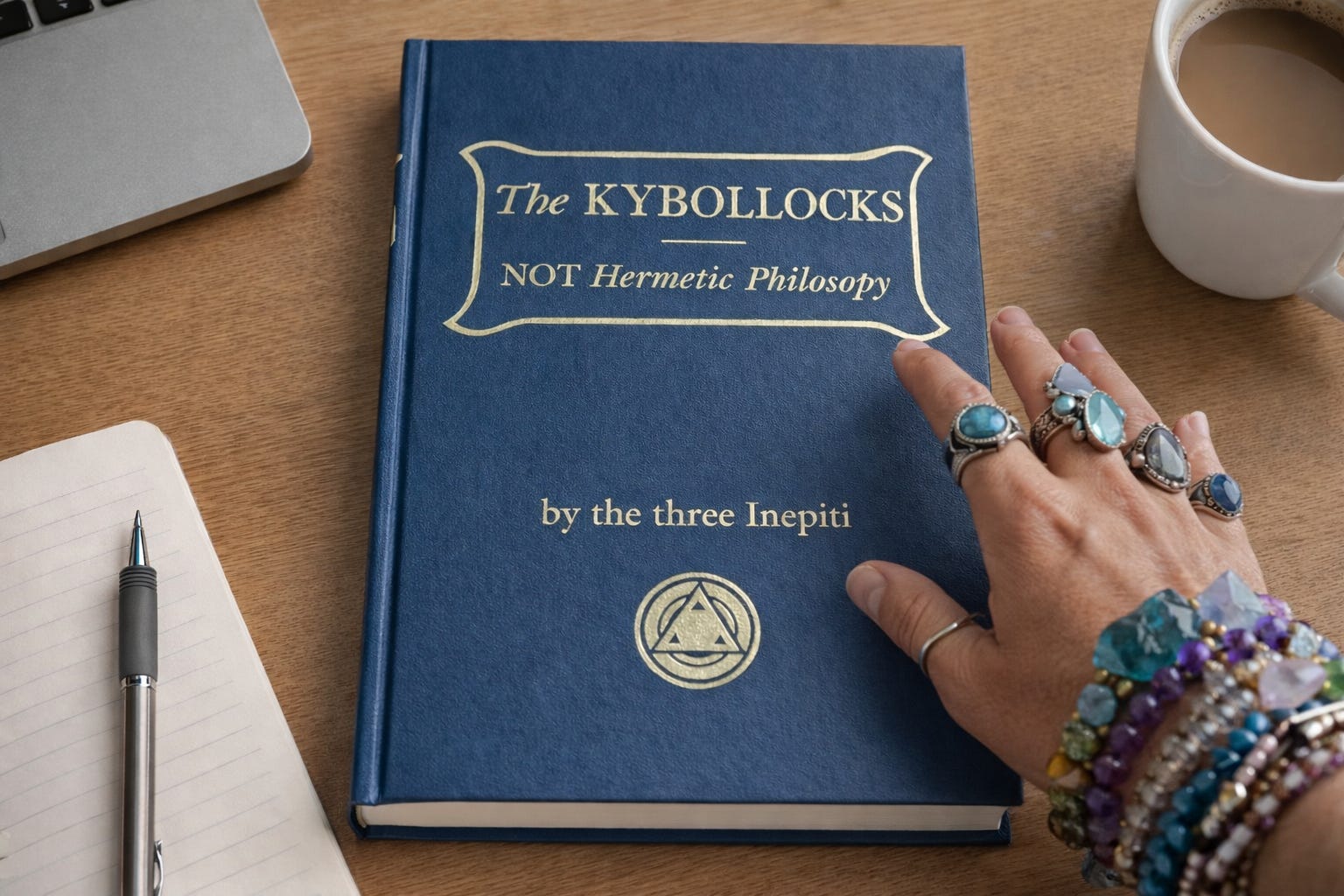
The Kybalion was a “must have” occult text for beginners for years, and it had a big influence on other members of Builders of the Adytum and me, helped along by the myth that Builders of the Adytum founder Paul Foster Case was one of the anonymous writers.
More recently, one of its ideas, “the Law of Attraction”, was recycled by the New Age marketing phenomenon “The Secret”, which is what happens when a vague metaphysic meets a cash register.
As I have progressed along the path, the ideas of the Kybalion have become less important to me, mostly because they do not work. A book can be old(ish), popular and quotable, but if it sells itself as an instruction manual for reality, then it has to cope with reality pushing back.
The seven principles or laws
For those who came in late, the Kybalion says there are seven principles or laws by which the universe works, and it wants you to treat them as the hidden operating system of everything. These are the ones people parrot as “Hermetic principles,” as if they were chiselled into the Emerald Tablet rather than printed in Chicago.
The Principle of Mentalism: All is Mind: the underlying reality of the universe is mental, and that everything that exists is a manifestation within a universal, living consciousness. In this model, matter, energy, and events are not independent substances but expressions of thought within a cosmic mind, which implies that by altering one’s own mental state, one can influence external conditions.
Principle of Correspondence: there is always a correspondence between the laws of phenomena of the various “planes” of being and life, with harmony and agreement between “The Physical Plane,” “The Mental Plane”, and the “Spiritual Plane.”
Principle of Vibration: motion is manifest in everything in the Universe, nothing rests, everything moves, vibrates and circles, and to change one’s mental state is to change vibration. The book says you can do this by an effort of Will, deliberately “fixing the attention” upon a more desirable state, which is a fancy way to sell focused daydreaming as physics.
Principle of Polarity: everything is dual, has two poles, has its opposite, and paradoxes can be reconciled when these extremes meet.
Principle of Rhythm: everything is manifested in a measured motion backwards and forward in a pendulum-like movement.
Principle of Cause and Effect: there is a cause for every effect, an effect for every cause, and there is no such thing as chance, only causes you have not spotted.
Principle of Gender: gender is manifested in everything as masculine and feminine principles, on all planes, with the masculine giving out or expressing and the feminine receiving impressions.
There is a lot there that makes sense if you read it as a loose metaphor, but the danger is taking it at face value and assuming these are absolute laws governing magic. They do not, and the more seriously you take them, the more time you waste explaining away why they did not work this time.
The book’s dodgy pedigree is not the real problem
Firstly, the book itself was written by William Walker Atkinson, and the Kybalion, which the book quotes, never existed as an ancient text. I am not going to sound off about it being a fraud because it does not matter who wrote it; if the information is valid, it is, unfortunately, deeply philosophically borked.
The main problem is that the book is soaked in New Thought, a movement that excels at confidence but is terrible at falsifiability. Atkinson was a proponent of New Thought, which influenced Paul Case, and he loved writing anonymously under the names Theron Q. Dumont and Yogi Ramacharaka.
New Thought teaches that God is omnipresent, spirit encompasses all reality, human selfhood is divine, and positive thinking promotes healing by counteracting sickness rooted in the mind. It says all disease is mental in origin, so if you sit and visualise what you want with enough emotional power, you will get it, which is a handy doctrine if you want to blame sick people for being insufficiently cheerful.
This was the basis behind Paul Case’s Seven Steps, which he claimed were the keys to magic, and he applied them to psychology by arguing that visualisation alters unconscious thinking and transforms your existence.
Some of this is somewhat true, because focus, habit and expectation do shape behaviour, but the occult trap is mistaking that for a universal law.
If a law or principle is true, it can be tested, and not just with cherry-picked success stories and a wink.
The Kybalion shows positive proof of its ideas and avoids the negatives or hides behind “get out of jail free” clauses that let the universe bypass the so-called rules whenever you notice them failing.
So, you are left with the conclusion that these are ideas that sometimes work and therefore cannot be laws of the universe.
My objections might sound like nitpicking, but when small things do not work, the “law” must fail, because laws do not get to be part-time.
What breaks the laws
Principle of mentalism
While I can accept that the universe is all mind, I cannot accept that it is all there is.
A mind, or consciousness, is definable, and it has rules which can define it, yet there must equally be an infinite part of god which can only be defined by what it is not, and it would not be mind.
If Thoth is an expression of the divine mind, he emerged from the unknowable darkness, which is not a synonym for a big brain in the sky.
The Kybalion wants to sell a neat monism, but it does not earn the right to declare that the only thing in existence is mentation.
In magic, mentalism turns every failure into an accusation. If all is mind, then when your operation flops, the answer becomes “your mind is weak” rather than “the model is wrong”, and that is a perfect scam mechanism.
It encourages a kind of cosmic narcissism, in which everything becomes a projection of the operator’s inner weather. That can be psychologically useful in small doses, but as a metaphysical claim, it is lazy, and as a magical rulebook, it is dangerous.
Principle of correspondence
While it is true that anything that happens on one plane can manifest on another, that does not mean that it does. A person can have an idea for a new building, and that does not mean such a structure will necessarily come to life on Earth.
Many ideas remain unrealised, and many rituals fail. The Kybalion wrongly equates possibility with certainty and faults individuals when results are not guaranteed.
Correspondence gets used as a licence for sloppy analogy, where a poetic resemblance becomes proof. You can say “as above, so below” until you are hoarse, but you still need to show that the above maps onto the below in a way that produces repeatable results every time.
If correspondence were a law in the strict sense, you would expect stable conversions between planes, like a reliable transformer. Instead, you get vague inspiration, sometimes useful, often misleading, and that is a more creative technique than any law.
Principle of vibration
All things are in motion and vibrate, which is somewhat true, and stability often appears to be an illusion. But it depends on relativity, because an atom is stable relative to itself, and while the solar system might be moving, it is held stable by gravity.
If you put a stone on a table in front of you it does not move. It is not arguable to say “it moves very slowly or you can’t detect it” because, in fact, it stays still relative to everything else that matters in that moment.
The Kybalion uses “vibration” like a magic word, turning attention into a lever on the universe. It sounds scientific and modern, and it lets people pretend their moods are tuning forks.
The problem is that you can always retcon a vibration story after the fact. If you get what you want, your vibration was aligned; if you do not, your vibration was blocked. Either way, the doctrine never risks being wrong.
Used carefully, changing your mental state can change your choices and determination, maybe even how people perceive you. That can shift outcomes, but that is psychology and behaviour, not proof that reality is a mood ring.
Principle of polarity
Despite being a separate law, this has similarities to the law of gender, which specifically talks about sex and not positive and negative duality, even if the Kybalion tries to mush them together when convenient.
Heaven forbids the “Three Adepts” only saw a difference because seven is a perfect number, and six would require them to make up something different. Once you notice the numerology, you start seeing the scaffolding, and the whole thing looks less like wisdom and more like an edited pamphlet.
Also, the principle of polarity counters the first law, which says the universe is one thing and mind. You cannot have strict monism and strict dualism without doing philosophical gymnastics.
Physicist David Bohm did see evidence that the world was dualistic, treating information as just as important as substance or intensity, and one cannot be reduced to the other. That implies our world is not one thing, at least not in the simplistic way the Kybalion flogs it.
I do not believe in the duality of extremes, and I do not believe there is pure good or evil in our world, but something like 50 shades of grey. Polarity is often a trick of categorisation, where you force a spectrum into two groups, which are then mistakenly presented as absolute truths.
Polarity is useful for managing tensions and balancing opposing forces, but as a cosmic law, it fails in areas that don’t conform, and there are many.
Principle of rhythm
This does not always happen. Light, for example, behaves as a wave and a particle, and you cannot reduce that to a pendulum metaphor without shaving off most of what matters.
It is possible to create objects that do not operate rhythmically, and evolution is not rhythmic. History does not swing like a clock, and your life is not obliged to obey a cosmic metronome just because the Kybalion likes tidy swings.
Rhythm is another principle that survives by vagueness. If things cycle, the Kybalion claims victory, and if they do not, it says you are looking at the wrong scale or that you are too dense to perceive the deeper swing.
Nature, biology, astronomy, and economics all have rhythms and cycles, but not every process is governed by periodicity.
The phrase “everything swings back” can serve as a helpful psychological tool during difficult times, but when used to describe how reality works, it’s no more reliable than a fortune cookie saying.
Principle of cause and effect
Again, this is sort of true, and it was a standard scientific belief in the past that works in plenty of everyday contexts. It is also getting a kicking by modern science, and that is before you even get into philosophical headaches.
This is an area for research, and it could mean that rather than being an occult absolute, it is just old science dressed up as metaphysics. The Kybalion does that a lot, taking the intellectual fashion of its era and marketing it as a timeless secret doctrine.
If A causes B then A always has to come first, and the relation must be stable enough to rely on. So, war causes death, except war does not always cause death and death is not always caused by war, which means you end up talking about probability and conditions. Another classic argument is that day follows night, but at no point could you say that night causes day.
Lately, any concepts that cause and effect have any reality at all have been taken a knock by quantum physics, where events happen before they should and in unexpected places.
If you can only generate a probability of the same effect from the same cause, then you must doubt your cause, or accept an inherent randomness that can nullify simple cause and effect. Either way, the Kybalion’s “no chance” boasting turns into a tantrum when you apply it outside the cosy zones of everyday mechanics.
Magicians who lean too hard on cause and effect become control freaks (yes, that was deliberate). They start mapping everything as if the world were a machine that owed them predictable outputs, then get bitter when it behaves like a world full of other wills or accidents.
Principle of gender
Now I know this is supposed to be figurative, but the laws are supposed to apply to all of creation. Polarity is absent in various natural cases, including amoebas, yeast, and snakes.
The existence of parthenogenesis shows that polarity does not always apply in the physical world. That suggests it probably does not always apply to the mental or spiritual worlds either, unless you want to start inventing exceptions, which is the opposite of a law.
The gender principle imports Victorian assumptions, with the masculine cast as will and expression and the feminine cast as reception and impression. Even taken as symbolism, it bakes social prejudice into metaphysics and then pretends it is nature speaking. It ignores the reality of human sexuality and favours a totally black and white view, which only works if you are a US Christian nationalist.
When you apply that to magic, you get a cramped model of power and passivity.
It can lead people into thinking certain modes of action are “masculine” and superior, while other modes are “feminine” and secondary, which is sexism wearing robes.
The bigger problem is how the book teaches you to think
No doubt people will find fault with my logic and methods, but that is not really the point. The issue is that there are serious doubts about whether the Kybalion produces an absolute set of “laws” worthy of a magician.
Given the absolute tone of the book, you have to question whether its status in an occultist’s bookshelf is worthy, or if it is just a collection of fake science manifesting as occult truth.
It presents itself like a master key and behaves like a mood board, and that gap matters when people build practice on it.
A law is meant to survive hostile testing.
The Kybalion survives by being slippery and by giving the reader a ready-made excuse for every failure, usually wrapped up as “you did it wrong” or “you were not ready.”
That is great for protecting the book’s reputation and terrible for helping anyone learn.
A useful system teaches you how it can fail and what to do when it does, because failure is where the real information lives.
Why modern critics keep having to repeat the obvious
Longtime readers of modern occult corners will have seen the same argument play out repeatedly, because the Kybalion keeps getting recommended as if it were a primary Hermetic text.
People who read the Corpus Hermeticum (https://farrellnick.substack.com/p/learning-gnosis-the-hard-way), the Asclepius and related material then have to explain, patiently or not, that the Kybalion is basically New Thought borrowing Egyptian themes.
One critic put it bluntly, and I am keeping the quote intact because it nails the tone: “Regular reminder: the Kybalion is a farcical waste of ink, paper, and time, and is not representative of Hermetic philosophy, instead being a work of New Thought dressed up in Egyptomaniacal cosplay. There’s literally everything else better to read than the Kybalion.”
The Kybalion’s introduction plays itself up, and it is worth seeing how hard it leans on theatre.
It starts with: “We take great pleasure in presenting to the attention of students and investigators of the Secret Doctrines this little work based upon the world-old Hermetic Teachings.”
It says its purpose is not the enunciation of any special philosophy, but to hand students a statement of truth to reconcile bits of occult knowledge that appear opposed.
Then it claims: “Our intent is not to erect a new Temple of Knowledge, but rather to place in the hands of the student a Master-Key with which he may open the many inner doors in the Temple of Mystery through the main portals he has already entered.”
It tries to build authority by claiming Hermes Trismegistus is the “Great Central Sun of Occultism”, that Hermetic teachings are the root of basically everything, and that the true fragments have been guarded across tens of centuries.
Then it shifts into contempt for outsiders, including this choice bit: “They reserve their pearls of wisdom for the few elect, who recognise their value and who wear them in their crowns, instead of casting them before the materialistic vulgar swine, who would trample them in the mud and mix them with their disgusting mental food.”
That is sales copy for people who like being told they are special. It is also the kind of framing that makes readers defend the text as part of their identity, which is why criticism hits nerves.
This is the sort of mess you see on social media, where someone tries to defend the Kybalion as harmless entry-level reading. You will find people defending it with the same zeal as those who defend Apple products or works by Franz Bardon. The Kybalion encourages that sort of behaviour because it makes standing up to people who practice magic feel like proof. If “vibration” is your main metric, then being challenged feels like bad vibes, and you can dismiss it without thinking.
For example, in one exchange, a Kybalion defender said the book offered entry-level concepts, and it was better for noobs to start with that before leaping into the Key of Solomon.
However, the Kybalion’s ‘ principles’ are a waste of time at best and dangerously misleading at worst, and they often require unlearning and serious deconditioning when getting into serious magic.
What the Kybalion does to beginners
The first harm is confusion. The Kybalion claims to be Hermetic, but it is not, and it leads people to expect neat lists of laws when they move on to classical texts. The Corpus Hermeticum is available and does not contain anything like the Kybalion. So, if a student wants to understand Hermetics, they should not read the Kybalion.
A further issue is that many lessons prove useless or even harmful, as they encourage unfalsifiable thinking in beginners, which can hinder future progress by discouraging reality checks.
The third harm is that it is so basic that it does not do much besides say “there are things out there”, and that can be motivating, but it is also empty. Feel-good kind of truths can get someone off the sofa, but they can also keep someone stuck at the level of slogans.
That is not a small issue, because people make choices about practice and community based on labels. If you point them at the wrong shelf, they will spend years defending a misunderstanding.
It’s just a gateway is not a strong defence
We saw above that some argue the Kybalion piques people’s interest in Hermeticism, making it a valuable gateway. That can happen, but it creates a gateway tax, because the reader then has to unlearn the idea that Hermeticism is a set of tidy modern axioms.
If you read the Kybalion and then go to the Corpus Hermeticum expecting an easy list of rules, you will likely bounce. You will call the classical texts “too hard” or “too old”, then retreat to the comfort of a book that never risks being wrong.
Even if you do push through, you will spend time trying to find New Thought doctrines in the Hermetica, which are not there.
If you want the actual Hermetic material, the early texts are challenging, sometimes inconsistent, and require interpretation; they do not simplify into a handful of slogans.
The Kybalion’s real trick is pretending it is immune to evidence
The Kybalion uses absolute statements but functions as motivational metaphors. Success makes readers feel empowered; failure leads to guilt, reinforcing the book’s authority.
It also invites people to treat coincidence as confirmation. If you “fixed your attention” and then something improved, you have a story, but a story is not a law.
The universe is full of noise, human life and magical practice is full of variables. A rigorous system clearly tests variables or acknowledges their poetic and psychological nature; the Kybalion does neither.
It should not be considered a serious guide for magicians; its format encourages readers to stop questioning when something sounds profound.
As a piece of New Thought with occult trimmings, it is tolerable. Taken as a Hermetic law, it leads straight to arguing over slogans, personal guilt when reality does not comply, and a lot of misplaced confidence.
You might want to have a look at Nicholas E. Chapel’s article, The Kybalion’s New Clothes: An Early 20th Century Text’s Dubious Association with Hermeticism, which goes into the history and origins of the Kybalion.

Love this article and appreciate the honesty towards BS teachings. Do you have any book suggestions that you know would better teach students the real truth? It can be beginner or advanced. A list would be awesome, but anything is greatly appreciated. Thanks!
I was once invited to teach a workshop on Hermeticism at a venue. The owner mentioned that he was looking forward to people learning about The Kybalion. When I explained that it isn’t actually Hermeticism, and that I would instead be teaching from the classical Corpus Hermeticum, the color drained from his face and he got angry. I quickly ended the conversation and left, and the invitation was soon rescinded.