
Gnostic cosmology is not a universal spiritual system
Don't mix things you don't understand

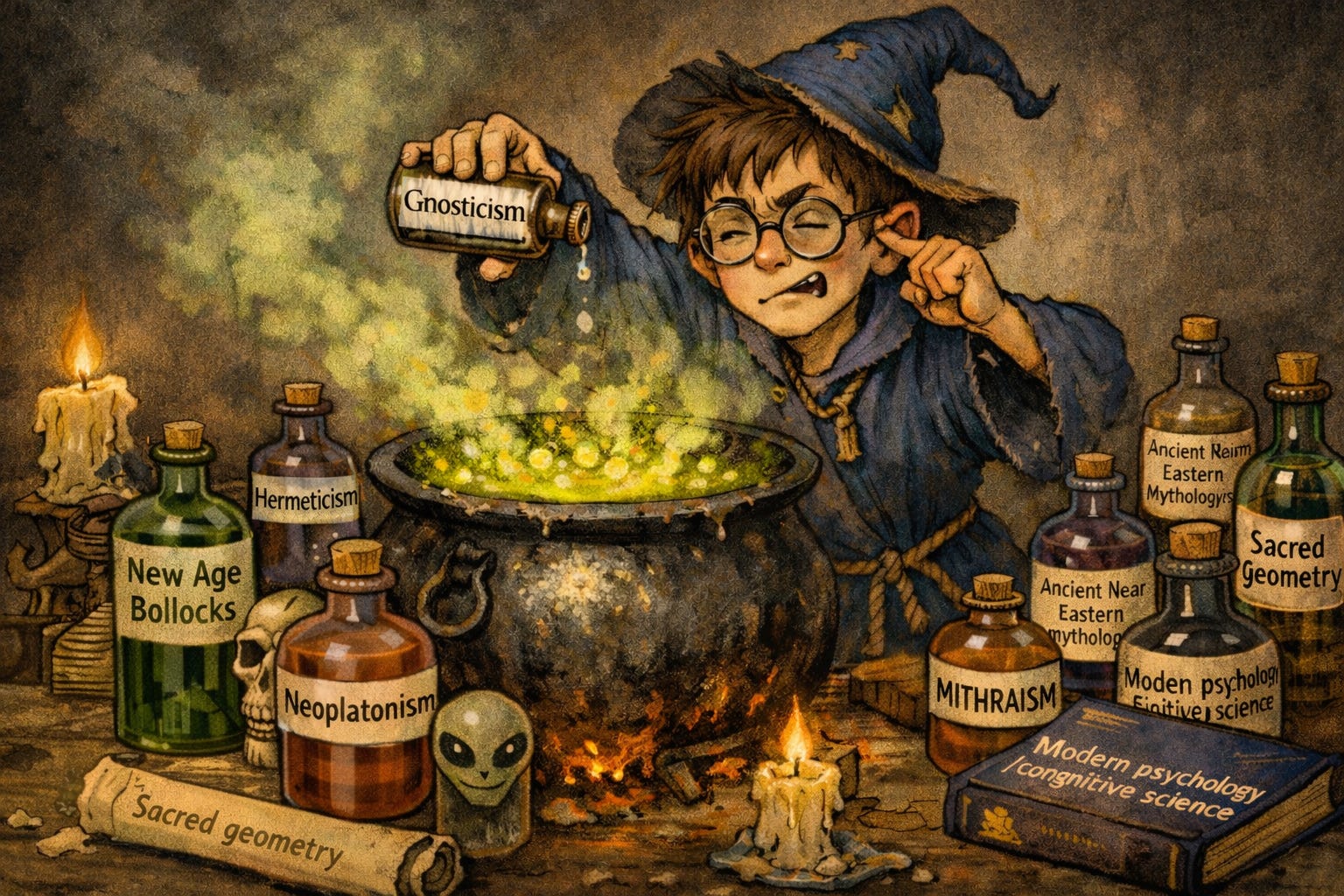
Before writing this article, I tried to map the logical sequence of the next topics in Gnostic studies following the path opened by the previous pieces. I realised something had to be addressed before continuing. Since I began exploring the meaning of gnosis, Gnostic cosmology, and the connections between these texts, the process has often felt like being led through a forest by breadcrumbs.
This is uncomfortable for someone born under Gemini and operating with the internal motto: “It’s late! It’s late!” The White Rabbit from Alice in Wonderland clearly had organisational issues, but at least he knew where he was going, while my inner white rabbit is just shouting at me. In Gnostic studies, the breadcrumbs sometimes disappear halfway through, and you are left staring at a text, wondering which century just ambushed you. Over time, I have learned to make peace with my impatience, since this subject can’t be rushed.
While browsing my usual Facebook groups, I recently noticed confusing posts about Gnosis and related subjects. Some bring together a melting pot of concepts, presenting information that once required in-depth research but is now tidied up by artificial intelligence to appear coherent and readable, essentially creating a mash-up of Plato, Gnosticism, Neoplatonism, Kabbalah, cognitive science, and a sprinkle of modern sacred geometry.
I don’t claim to know everything, but “ancient wisdom” often functions in modern spiritual discussions as a Linus blanket. It soothes people and produces an impressive number of enthusiastic reactions, fuelling debates that resemble a hotchpotch of ignorance, fluffy-bunny New Age thinking, and surreal responses. In practice, the operation pours incompatible cosmologies into the same container and stirs them with aesthetically pleasing AI language until the mixture looks smooth enough for followers to consume.
Readers of this blog will know that I approach the material from a different angle. Over the last articles, I have explored the Hermetica, Neoplatonic theurgy, the Gnostic cosmology of the archons, and the problem of the Demiurge because those traditions are not identical. I wrote about how certain deities should be approached, with the correct meaning in mind rather than romanticised interpretations for convenient repackaging. I even tackled the possible implications and relationships between magic and various quantum and field theories. Interactions between Hermetic philosophy, later magical practice, psychology, alchemical symbolism, and modern scientific language do exist, though they range from strong to extremely weak, and sometimes do not exist at all.
While ignoring those links would be intellectually dishonest, the difference lies in how those links are examined. The approach should be careful, asking where the similarities come from and what each system believed it was describing. A shared metaphor does not necessarily imply a shared cosmology, and a similar symbol does not prove that two traditions are secretly teaching the same principles. Intellectual honesty and patience are essential because the temptation to rush toward a grand unified spirituality is extremely strong. That is why we debunked modern approaches to alchemy, we wrote about the Kybalion, Bardon, and occult grifters.
When the sources are allowed to speak in their own voices, the landscape becomes more interesting. Hermetic texts propose a universe animated by divine intellect and accessible through ascent; Gnostic writings describe a fractured cosmos governed by flawed powers; Neoplatonic philosophy reconstructs a hierarchical order of emanations. Every system forms its own vision of reality and humanity’s place in it. While their similarities offer insight, their differences reveal even more.
That approach lacks the comforting simplicity of the modern spiritual smoothie, where every tradition dissolves into the same pleasant candy floss flavour. It does, however, preserve the intellectual integrity of the sources. And occasionally, when the breadcrumbs line up for a moment, it reveals a stranger and more challenging picture of the cosmos than any tidy internet synthesis.
I look at this modern trend and feel both disheartened and fascinated; it’s a phenomenon that deserves attention. In many of these discussions, the Demiurge seems to have changed identity. The old Gnostic figure of the ignorant cosmic ruler has become a neutral organising principle, almost a cosmic engineer whose task is to structure reality into measurable form. This viewpoint suggests that the universe appears to be an intelligent system, while human awareness develops by recognising how it operates. There are no fundamental flaws in existence, and everything is fine as it is.
Such narratives appeal because they avoid a troubling idea found in many ancient texts: the possibility that the universe is flawed, raising uncomfortable questions about whether the forces shaping reality care about human development at all. If this is the case, a divine spark trapped within such a system implies hard work and uncertainty, and the suggestion that not every individual possesses the same capacity for awakening can clash with modern sensibilities. An inclusive cosmology conveniently resolves these conflicts by replacing them with an image of universal participation in an intelligent system.
Once this psychological need emerges, ideas begin to reorganise themselves accordingly. Concepts that once belonged to different traditions slide together until they form a single symbolic language. For example, someone on Facebook juxtaposed Sophia from the Gnostic texts with the Shekhinah of Jewish mysticism, Inanna’s descent from Mesopotamian mythology, the planet Venus, and the lowest sphere of the Kabbalistic Tree. Each figure is presented as a variant of a universal feminine principle descending from the divine into the material world. The suggestion looks sophisticated and coherent, yet the historical traditions behind these figures never described the same events or reflected identical structures of reality.
Sophia enters the Gnostic myth as the figure whose action leads to the emergence of the Demiurge and the archontic world. In Jewish thought, the Shekhinah expresses the presence of the divine within creation and the community of Israel. Inanna’s descent tells a story about death and the loss of authority. Venus belongs to the astronomical and mythological language of the Greco-Roman world, while Malkuth is part of the medieval Jewish sefirotic system. Each tradition developed its own cosmology with precise internal relationships. The harmony appears only after their original context has been removed.
The language used to describe creation flattens complex doctrines. Another post suggested that Kabbalah speaks of contraction, Gnosticism of a fall, Neoplatonism of emanation, and physics of symmetry breaking, as if these ideas describe the same moment in the universe’s unfolding. The attraction lies in the belief that various traditions reveal one underlying truth.
Examining these doctrines reveals very different ideas. Lurianic contraction describes a divine withdrawal that allows creation to exist; the Gnostic fall concerns Sophia’s error and the emergence of an imperfect cosmic ruler; Neoplatonic emanation describes the overflow of the One into intellect and soul. Symmetry breaking in physics, by contrast, refers to the differentiation of fundamental forces in the early universe and belongs to an entirely different explanatory paradigm. The original ideas emerged from different cosmologies, developed in different centuries, addressing different problems.
Another lengthy online post claimed links between Zurvanism, Mithraism, and Gnosticism, merging them into a single symbolic system. It equated figures and concepts across these traditions and interpreted them as allegories for the human nervous system and “universal energy.” The example of the lion-headed god is another mess: the leontocephaline figure in Mithraism is one of the most disputed images in the cult. Scholars have associated it with time, fate, Aion, and several other possibilities, yet the post claims it is “often likened to Ahriman” and then links it to the Gnostic Demiurge as if this were a settled fact. The method identifies a visual resemblance and then smuggles in theological sameness. I could go on for hours; the examples are countless.
Metaphors are powerful because people interpret the world through recurring images and symbols across cultures. Myths like descending from heaven highlight universal tensions between spirit and form, while symbols resonate because of shared psychology. However, when symbolic parallels are taken as literal claims about reality, myths that once explained suffering or divinity become modern philosophical embellishments.
Artificial intelligence accelerates this process by using language models trained on extensive datasets to produce unified summaries of mystical traditions, merging commonly linked fragments into smooth narratives. Historical context is lost because the algorithm focuses on linguistic patterns instead of doctrinal differences.
An academic paper examines the evolution of the Demiurge, tracking it from Plato’s Timaeus, where he is a cosmic craftsman, to Gnostic mythology, which recasts him as an ignorant ruler presiding over a flawed world. This shift marks a change in cosmological thinking, moving from rational order imposed on chaos to a fundamental error at creation’s core.
The paper traces the concept through Neoplatonism, medieval theology, Renaissance thought, and into modern intellectual culture. As time progresses, the Demiurge evolves from a figure embedded in cosmological systems into a symbol representing various forces that influence human life. These include ideology, technological frameworks, political institutions, and even artificial intelligence, all grouped under this metaphorical label. The Demiurge serves as an archetype of control, whether seen as a psychological mechanism or a principle shaping institutions and technologies.
This example shows how a technical concept can become cultural symbolism. Once removed from its original context, the term acquires new meanings: writers use it to describe life within externally designed systems, science fiction imagines hidden architects behind simulated worlds, philosophers employ it when discussing the frameworks that shape perception, and technological networks are interpreted as modern agents of these forces. Plato’s ancient craftsman has become a metaphor for the unseen forces shaping contemporary existence.
It is extremely easy to fall into this mechanism because it carries a certain intellectual elegance. The history of ideas often reveals surprising connections between distant periods. I am not denying the existence of real associations and resonances, especially when examined from a psychological or archetypal perspective. A mythological figure can travel across centuries and acquire new meanings in response to changing cultural concerns. Ideas and symbols evolve, and traditions occasionally recognise echoes of one another.
However, when a metaphor replaces the original concept, it loses the meaningful structure needed for practical use. If the Demiurge shifts from its cosmological roots to a general symbol for any constraint on human freedom, it becomes so broad that it loses explanatory precision.
This is crucial for practitioners, as ritual systems rely on their traditional cosmology. Misunderstanding the cosmology fundamentally changes the practice.
Ironically, this is exactly the sort of confusion the Gnostic texts warn about. The archontic condition is not only expressed through external powers but through ignorance and misrecognition. If a cosmological framework is replaced by a soothing metaphor, the mind may wrongly assume it has attained true understanding, even as it navigates its projections and illusions.
When these cosmological distinctions blur, the reader encounters a single narrative about humanity confronting structures that shape the world from behind the scenes, and may be tempted to think: “I can pick one or the other, because they all lead to the same destination, don’t they?”
Our cultural roadmap reflects how we interpret reality, not reality itself. Ancient writers aimed to explain existence: Plato’s Demiurge offered a model grounded in eternal forms as the universe’s blueprint, while Gnostic myth traced suffering to a flawed creation. Each system provides a unique perspective on the origins of the visible world and its connection to the divine source.
The pattern shows an interesting cycle between academic research and public interpretation. Scholars outline how a concept has developed over time, and readers often take away the impression that the idea was always meant as a flexible metaphor. Online conversations speed this up by blending various historical phases into one broad philosophical statement about reality.
Observing that drift clarifies the challenge facing anyone who approaches Gnostic cosmology today. Over time, layers of philosophical, theological, psychological, and cultural interpretation have reframed the myth of the Demiurge and shaped how modern readers approach these texts.
A careful reading requires stepping back from this accumulation of meanings. The main question is: what did those writers think they were describing? The answer is found in Gnostic cosmology, not in modern metaphors. In these texts, the Demiurge is a figure in a narrative that explains the origin of the material universe and how humanity’s divine spark becomes trapped within it.
Restoring the original framework takes patience. The Demiurge returns to the place the texts assign him, as the ruler of the world who explains the divide between the divine realm and the material order. At that point, the myth regains its disturbing edge. The cosmos may be intelligent, but it is governed through hierarchy and deception. Humans carry within them a fragment from another origin, and gnosis begins when that fragment is recognised, and the powers that conceal it are overcome.
I don’t think the people producing such posts are acting in bad faith. Most are responding to the same curiosity that draws readers toward ancient texts in the first place. The problem is that ignorance, combined with the desire for quick and easy answers, is a bad mix. When enough parallels emerge, it is tempting to assume that all traditions refer to a single metaphysical process by different names.
Despite the persistence of such examples, it is important to approach Gnostic texts without falling into the same trap.
Before thinking about what a text reminds us of, focus on what it says. Spotting patterns can be useful, but it can also mislead. For example, seeing Sophia mentioned may prompt readers to immediately link her with figures such as the Shekhinah, Isis, Shakti, the anima, the unconscious, or even the idea of pure consciousness entering matter. These connections can overshadow the original text and keep its true meaning hidden.
A Gnostic document should begin by stating its central problem, because missing that point often causes confusion. Each cosmology responds to a distinct existential concern. If the starting point is overlooked, everything that follows is misinterpreted. The archons become psychological blocks, Sophia becomes a generic divine feminine, and the spark turns into a feel-good slogan about inner light. The entire thing then fits into the usual stereotypes of modern spirituality.
To start, read the source on its own terms and pay attention to the problems it seeks to address. Every cosmology has its own logic: it defines the highest reality, explains how the world came into being, describes what a human being is, and outlines why life involves struggle and how liberation might be achieved. Keeping these elements in mind helps the reader follow the system instead of rushing to compare it with others.
Once you examine Gnostic writings, their internal differences quickly become apparent. The term “Gnosticism” covers a range of texts. Some adopt a sharper anti-cosmic tone, while others focus more on recognition and the restoration of what has been forgotten. A reader expecting one uniform doctrine will already be half lost before the second chapter.
If you’re new to these materials, start by reading a clear cosmological text without overanalysing it and pay attention to the kind of universe it describes. Then read another similar source and compare the two, noting similarities and differences. Allow the connections to emerge from your own reading, noticing the inner response the text provokes. Only then does comparison become productive, revealing relationships between systems instead of being spoon-fed a prepackaged interpretation or assuming a universal similarity from the beginning.
A practical way to begin is to read a text such as the Apocryphon of John from start to finish without commentary. Only afterwards should one consult scholarly interpretation or comparisons with other traditions. Otherwise, the reader ends up studying the commentary instead of the text itself.
Gnostic myths use cosmological language to express their views on reality and should not be treated as poetry.
The paper on the evolution of the Demiurge illustrates how a concept drifts once it leaves its original cosmology. That trajectory is historically and theoretically interesting but of little use for practical understanding.
Gnostic writings reject a comforting universal spirituality; they attempt to explain why the world feels ordered yet fundamentally wrong, so avoid hammering a safer version of the universe into your mind simply because it helps you sleep better.
Resist the urge to turn every myth into a modern metaphor. The result may be less reassuring than the internet version of Gnosticism, but it will take you much further.
What if Sophia earths soul or aeon
Created a flawed demiurge but it potentially got worse from the destruction of Tiamat whose own destroyed ànd lost soul came flaying to earth ànd traumatized thé demiurge ànd Sophia to create this traumatized planet/plane. Maybe original Sophia was Eden ànd all we need to do is heal her/him…
Thén we heal this sector pf our galaxy.
I’ve studied many traditions and have put together a huge piece on this ànd it’s a work in progress.
Very good article also!
Thank you
https://shifthapens.substack.com/p/cosmogony-heaven-hell-aliens?r=b8pvb&utm_medium=ios
Each system is just that, a science to understand how things operate. As though they lead to the same thing but different pathways in a universal system. Some paths may fall short or fail to meet to others, but even if the path ends we tread through the remainder to the same end. ♾️🕉️