

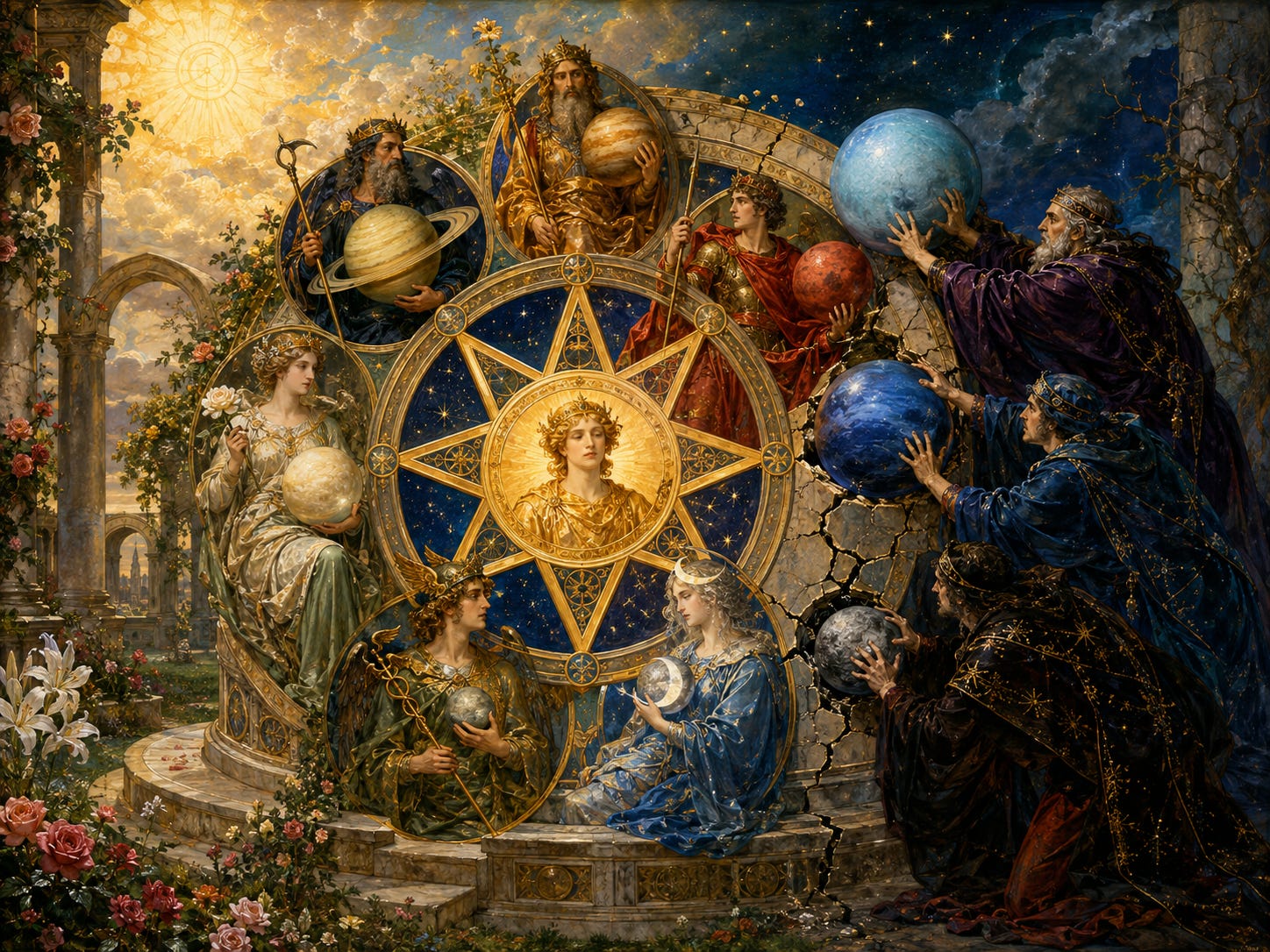
Whenever astronomers spot another frozen boulder in the outer darkness, magicians and astrologers rush to domesticate it with a colour, Tarot card, an incense, an archangel and a laminated table of correspondences. The universe expands, and the occult spreadsheet must keep up. The Golden Dawn was aware of Uranus and Neptune but did not integrate them into its sevenfold planetary magic system. Later magicians added them, followed by Pluto and a collection of snowballs, moons and hunks of rock.
But this approach confuses astronomy with magic. Uranus, Neptune and Pluto may be useful in some forms of modern astrology, but that gives them no automatic place in planetary magic. The traditional system is built around seven visible wandering lights: Saturn, Jupiter, Mars, the Sun, Venus, Mercury and the Moon. These are woven into the days, hours, metals, colours, virtues, vices, angels, spirits, numbers, magical squares and zodiacal rulerships.
The system is internally coherent, and hammering in three more bodies knocks out its load-bearing beams. Agrippa describes sacred numerical tables distributed among seven planets, beginning with Saturn’s three-by-three square. The system developed over centuries without requiring expansion, while adding three planets destroys its symmetry.
A big issue is that modern planets were named by astronomers, who gave them mythological names, and those meanings often bear little resemblance to the actual gods or their myths.
