
When the Storyteller Devoured the Magician
What we should learn from Dion Fortune

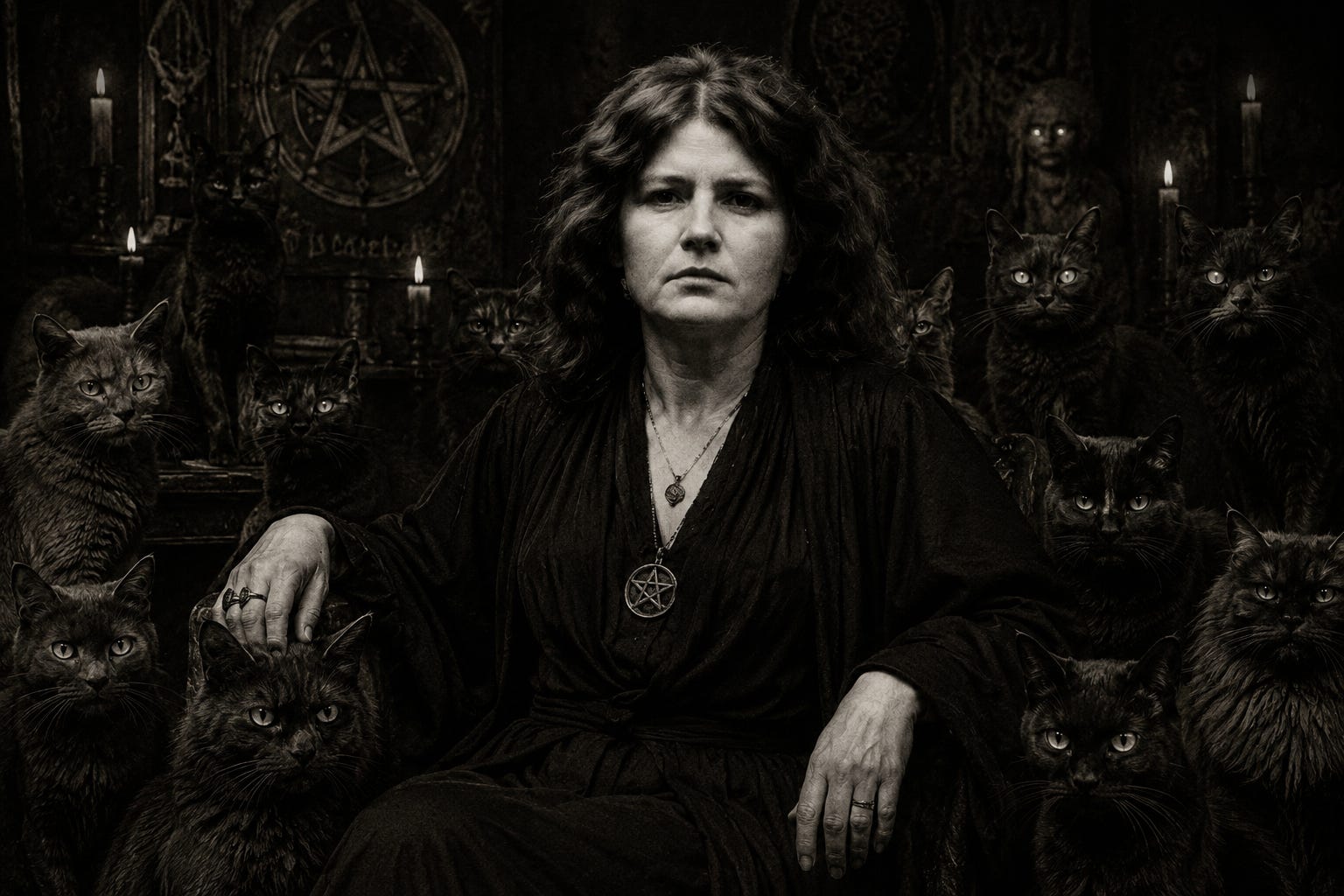
Dion Fortune’s greatest weakness grew directly from one of her greatest strengths: an extraordinary ability to turn invisible forces into vivid images, personalities, and dramatic events. This talent made her a powerful ritual magician, an influential teacher and one of the few occult novelists whose fictional magic occasionally feels as though it might work. Unfortunately, she became increasingly unable to distinguish between a useful magical story and an event which had happened.
Her imagination did more than illustrate magical ideas, because it reorganised memories, absorbed other people’s experiences and transformed personal disagreements into episodes from a secret occult war. Cats became astral weapons, cracked doors became physical evidence of magical combat, and inherited Golden Dawn lore returned as incidents from Fortune’s own life. By the end of her life, Atlantis had acquired temples, priesthoods, political factions and architectural details, with the special twist that Fortune had led its colonists after the whole lot sank.
Fortune was not a fraud and believed most of what she wrote about herself. Her failure lay in allowing imagination to replace evidence whenever an experience offered a satisfying story.
The Making of Dion Fortune
Dion Fortune was born Violet Mary Firth in Llandudno on 6 December 1890, into a prosperous English family. Her magical name came from the family motto Deo, non fortuna, meaning “by God, not chance.” She became involved in psychology, mediumship, Theosophy and ceremonial magic before joining the Alpha et Omega, a surviving Golden Dawn branch, during 1919. Her teachers and associates included Theodore Moriarty, Maiya Curtis-Webb and J. W. Brodie-Innes, each of whom influenced a different part of her developing system. She later founded the organisation which became the Fraternity, and eventually the Society, of the Inner Light before dying from leukaemia during January 1946.
Her achievement was considerable, because she preserved practical Qabalah while much of British occultism dissolved into Theosophical platitudes, spiritualist theatrics and elderly gentlemen quarrelling over the authentic Secret Chiefs. The Mystical Qabalah remains one of the clearest introductions to the subject because Fortune understood how symbols behaved within consciousness. She could explain a Sephirah as a living field of experience instead of another box on an increasingly complicated diagram.
Fortune also understood ritual construction, group organisation and the difficult business of creating a coherent magical atmosphere. Her work encouraged the later revival of goddess spirituality and helped restore myth as a practical instrument within modern occultism. Magic consumed almost every part of her life through seasonal rituals, Egyptian and Arthurian symbolism, trance communication and the imaginative construction of inner-plane temples.
Imagination remains essential to magic because it gives form to forces which cannot otherwise be perceived or directed. Unfortunately, imagination also produces convincing rubbish with an efficiency that should make every magician twitch at the thought of personal revelation.” A magician must separate symbolic perception from personal projection, yet Fortune’s autobiographical stories show how often she failed to apply her own discipline.
The Unreliable Witness of Psychic Self-Defence
The worst evidence appears in Psychic Self-Defence, where Fortune insists that she avoided second-hand accounts and relied upon cases within her personal experience. She dismisses stories about somebody whose friend knew somebody who once saw a ghost, while sensibly declaring that witnesses must be cross-examined. The remainder of the book demonstrates how little cross-examination Fortune’s own stories received once they had developed a suitable atmosphere.
Fortune repeatedly warns that alleged psychic attacks are rare and that illness, fraud, suggestion and psychological disturbance should be excluded before occult explanations are considered. One memorable obsession turns out to be constipation and is successfully exorcised with castor oil, which remains among the book’s more reliable banishings. She also recommends consulting qualified doctors whenever physical symptoms are present, advice which inexperienced magicians should probably embroider onto their robes.
Then the storyteller takes over again, improving each account until inexperienced readers are given nightmares when they should have received practical instruction. I was one of those readers, which is why I know how easily Fortune could turn every unexplained noise into evidence that something unpleasant had arrived from the astral plane.
The Geomantic Drain Demon
Fortune recounts experimenting with geomancy while insufficiently trained, although the exercise formed part of her Golden Dawn work. As Fortune tells it, every form of divination begins by evoking the genius which governs its operation. She claimed that geomantic genii were spiritually inferior and that drawing the figures on paper had offended them because wet sand should have been used. A terrible smell of drains then filled the room and disappeared only after Fortune performed a banishing ritual. She regarded the smell as objective proof that her experiment had invoked something unpleasant from the lower astral regions.
Almost every technical claim in this little yarn is wrong, although Fortune should have known what the exercise required. Geomancy certainly has historical associations with earth and sand, while its Arabic name, ʿilm al-raml, means the science of the sand. Medieval European authorities nevertheless accepted parchment or paper, while the invocation of a presiding spirit belonged specifically to the Golden Dawn approach. The figures are created from random lines of points before being reduced and judged through their relationships within the shield and house charts. Wet sand had not been standard European practice for centuries, and earlier geomancers somehow completed their work without reporting sewer elementals.
The story shows Fortune’s issues: either she knew just enough geomancy to frighten herself and turned that into a lesson for everyone else, or she made it up. Giving her the benefit of the doubt, once the smell appeared, she used her expectations to explain it, while the gaps in her knowledge became proof that geomancy concealed dangers, she had somehow uncovered.
The Plague of Cats
Fortune claimed that her household became surrounded by black cats after she had offended Moina Mathers. The animals crowded neighbouring doorsteps, appeared near her associates’ workplaces and filled the surrounding area with their smell. Fortune then saw an enormous tabby thought-form, supposedly twice the size of a tiger, descending the stairs inside her home. When the street eventually filled with yowling cats, she performed an exorcism before the animals disappeared and the visitation ended.
Alan Richardson regarded the account as a characteristic Fortune story, powerfully told but historically confused in several important details. He suggested that Annie Horniman made more symbolic sense as the mysterious cat woman, although she was not involved in Mathers’ Alpha et Omega. Horniman’s nicknames included “Tabbie” and “Puss,” while Mary K. Greer confirms that Moina was called “Bergie.” Fortune had apparently attached the attack to the woman already occupying the role of villain inside her private magical drama.
Fortune’s quarrel with Moina probably happened when too many local cats were around, and her imagination did the rest. Before long, the ordinary moggies had become furry delivery systems for whatever magical nonsense the story needed. When the exorcism ended, and the cats buggered off, Fortune found her conclusion wrapped and labelled for publication.
The enemy had acted, signs had appeared and a ritual had worked, allowing everyone to imagine that a junior magician had bested an adept like Mathers. This pattern runs beneath many Fortune stories, because every crisis eventually places her above the teachers, adepts or dangerous occultists who originally held greater authority.
The Mysterious Death of Netta Fornario
Netta Fornario’s death gave Fortune something better than another suspicious cat story, because it involved a real mystery and a former member of the Alpha et Omega. On a Tuesday afternoon in late November 1929, the body of Fornario, 32, was found on Iona wearing only a cloak. Later versions placed her beside a fairy mound south of Loch Staonaig, although the known facts are considerably less picturesque.
Fortune suggested that Fornario’s association with Moina Mathers had contributed to her death through the same pattern of psychic attack. She claimed that scratches had appeared on Fornario’s body and connected them with marks supposedly found upon Mathers’ other victims. Those scratches do not appear in other reports, while Mathers had already been dead for sixteen months and was unavailable for further cattiness, even with a surviving thought-form.
Francis King acknowledged that most readers would conclude Fornario suffered from severe schizophrenia and believed herself attacked, which remains the likeliest explanation. Fortune took a sad and uncertain death, added details unavailable elsewhere and fitted the result into her continuing campaign against Moina Mathers.
The Abramelin Story
Fortune’s use of the Abramelin incident is more complicated because she did not simply steal the story without acknowledgement. In Psychic Self-Defence, she identifies its source as a letter by H. Campbell published in The Occult Review during December 1929. Campbell described making an Abramelin talisman without adequate knowledge, suffering terrifying apparitions and eventually receiving help from an unnamed female friend. Fortune reproduced Campbell’s letter at length before incorporating it into her warning about the dangers surrounding ceremonial magic.
Her arrangement encouraged readers to assume that Fortune herself had been the unnamed woman who rescued Campbell from his experiment. Campbell was a high-level New Zealand magician associated with Whare Ra at Havelock North, and the woman who helped him was Harriet Felkin. Fortune probably never met him, which makes her implied appearance in the rescue considerably more impressive than ordinary geography permits.
Calling it plagiarism would be difficult because Fortune credited Campbell when she reproduced his original version. The appropriation came from the way she placed another magician’s ordeal among her revelations and made herself the authority who explained what had really happened. As later occult writers repeated the story, Fortune became associated with a rescue carried out by somebody else.
This was how Fortune made stories about her without erasing the person who had told them. She absorbed each narrative into her magical universe until it became secondary, and everything orbited her.
The Indian Occultist and Brodie-Innes
The most suspicious example concerns Fortune’s encounter with an unnamed Indian occultist, whom Richardson identifies as the Theosophist B. P. Wadia. His belief in Indian spiritual leadership offended Fortune’s conviction that Britain possessed a unique occult destiny within the world. Soon after withdrawing from his work, Fortune sensed a hostile presence while talking with a friend beside a gas fire. She saw Wadia’s projected form enclosed in yellow mist before sending her companion outside and drawing a protective pentagram. The apparition shattered as Fortune used divine names, while a loud crack provided the required physical confirmation. Her friend returned and discovered that one panel within the nearby door had conveniently split into two.
Fortune interpreted Wadia’s belief in India’s spiritual importance as a possible attack upon the group soul of Britain. Political and racial anxiety became occult diagnosis, while an Indian challenging British authority became an agent psychically penetrating the empire.
Fortune’s description follows the same pattern as an earlier Golden Dawn story written by J. W. Brodie-Innes, under whom she had studied. In his Flying Roll, “An Exorcism,” Brodie-Innes describes sensing a vampiric elemental in a gaslit room before an inner adept guides him through the pentagrams and divine names needed to force it into manifestation. The thing appears as a foul shape and is then struck with projected force, leaving Brodie-Innes with unpleasant physical sensations afterwards.
Fortune did not copy the story word for word, because she turned the elemental into a living Indian opponent, removed the guiding adept and placed herself firmly in charge. She added the cracked door, which supplied the physical proof every good occult story apparently needs when the witnesses are otherwise inconveniently absent. Even with these improvements, the two versions follow the same route closely enough to make coincidence look rather overworked.
Fortune presented the incident as independent evidence that her method of banishing worked against a projected occult attack. However, her method was a shortened Pentagram Ritual, while the example followed a Flying Roll, she already knew very well. The story may reveal the power of magical suggestion more clearly than it proves Wadia projected himself into Fortune’s sitting room.
The cracked door contributes nothing except physical confirmation, because doors split for many ordinary and thoroughly unmagical reasons. Only a born novelist could persuade one to wait until the precise instant required by the developing plot.
Atlantis Takes Over
Fortune’s Atlantean material shows the storyteller entering her final imperial phase and claiming an entire civilisation as supporting scenery. She had reported far memories of Atlantis since the 1920s, when she initially advised readers to treat them with reserve. During the later 1930s, those visions expanded into an elaborate magical civilisation connected with Glastonbury, Avalon and Fortune’s previous incarnations.
Her Atlantis contained a great Sun Temple whose black-and-white paving surrounded pillars serving as enormous gnoms. A separate Sea Temple trained seers and priestesses, while the Sun Temple included a Hall of Mirrors and a subterranean Hall of Images. Its priesthood developed internal disputes, political responsibilities, specialised initiations and disastrous magical accidents capable of damaging an entire civilisation. Fortune also described Atlantean bloodlines, forehead markings, social classes and the disposal of malformed infants with remarkable confidence.
The lunar current entered through the Priest of the Moon and eventually reached the temple developed within Moon Magic, her unfinished final novel. These imaginative temples were magnificent magical constructions capable of altering consciousness and providing powerful settings for ritual experience. Fortune’s mistake was to treat their accumulating detail as evidence that she had recovered the architecture and history of Atlantis.
Specificity proves only that the imagination has been busy, because novelists routinely know the wallpaper and childhood traumas of people who never existed. Fortune’s imagination was exceptionally disciplined when constructing worlds, which made those worlds compelling and increasingly dangerous to mistake for memory.
Her Atlantis reproduced the values and anxieties of Fortune’s environment through empire, priestly hierarchy, racial destiny and fear of civilisational decline. Atlantis became the British Empire collapsing beneath the waves while Fortune watched from a previous incarnation near the command deck.
Learning from Dion Fortune
Fortune could not always tell where an event ended, and her imagination, training and expectations began. Some of her stories contain genuine occult experience, but she kept improving them until nobody could tell what had happened and what she had added afterwards. In the process, the human Violet Firth vanished.
A vision can contain useful information without proving that anything happened outside the magician’s own head. A ritual may work perfectly well even when the explanation is wrong, because doors crack and cats gather without taking orders from Moina Mathers. Fortune understood this when judging other people’s experiences but became less careful whenever the story placed her at the centre.
Fortune’s storytelling always placed her near the centre, and later British magicians copied the habit with depressing enthusiasm. She considered herself chosen by hidden adepts, attacked by dangerous occultists and entrusted with the spiritual destiny of Britain. She also remembered priestly incarnations in Atlantis, while opponents suitably became black magicians or instruments serving hostile currents.
Had Fortune admitted that these beliefs were personal and might possess no importance outside her imagination, she might have escaped the worst consequences. Instead, followers since the 1940s have copied her example and declared themselves equally important because similar imaginary friends confirmed similar private mythologies.
None of this destroys Fortune’s magical work, because she was brilliant at creating myths capable of moving consciousness. Her temples and inner-plane contacts remain effective imaginative forms because magical symbols have never required historical passports. The Mystical Qabalah survives because it organises experience, while her novels survive because they openly use narrative as initiation.
Psychic Self-Defence remains her weakest major work because it requires polished stories to function as objective evidence. Throughout that book, the novelist dresses herself as a witness and proves unable to stop improving her own testimony.
Fortune’s tragedy was that she possessed enough authentic ability to make these inventions completely unnecessary within her teaching. She was an excellent magician who could have taught more clearly by admitting uncertainty whenever experience resisted a tidy explanation. Instead, she repeatedly converted uncertainty into adventure until the storyteller who created Dion Fortune finally consumed Violet Firth. What remained could command temples, nations, spirits and previous incarnations, but could no longer be trusted with cats.
Paid subscribers can download and hear this article below the paywall
