
When cosmic wisdom is racist
How Blavatsky smuggled nineteenth-century racism into modern esotericism

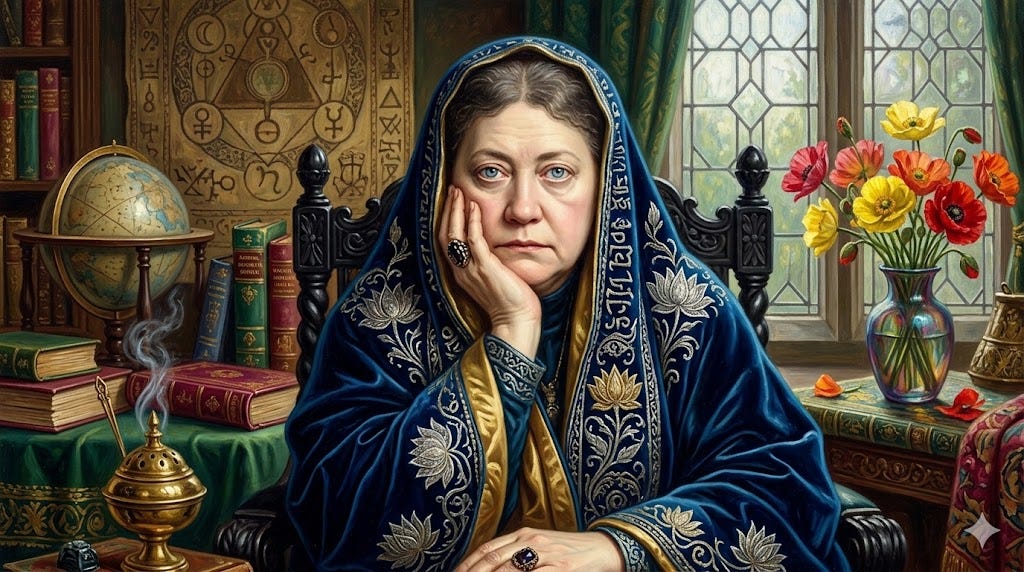
One of the prime movers and shakers of nineteenth- and twentieth-century occultism was Helena Petrovna Blavatsky and her Theosophical movement. It is difficult to find an occult current which was not influenced by her or by those who followed her. These include Golden Dawn leaders, Dion Fortune, Rudolf Steiner, Alice A. Bailey, the New Age movement, and even Aleister Crowley.
Blavatsky created a highly structured cosmological framework packed with details, which appeared to present a complete picture of the universe. Her system blended material from many traditions in a sweeping, syncretic approach, which appealed to those who wanted the universe neatly organised and explained.
The Root Race Theory
To understand the problem properly, it is necessary to explain what Blavatsky meant by “root races,” because the idea is stranger than many people realise. According to her cosmology, humanity does not simply evolve biologically but progresses through a series of spiritual “root races,” each representing a stage in the development of human consciousness. These races are not just ethnic groups but vast cycles of human evolution.
Blavatsky described seven of these root races. The earliest two were supposedly non-physical beings inhabiting a primordial world. The Third Root Race, sometimes associated with the mythical continent of Lemuria, represented the stage when humanity supposedly developed physical bodies. The Fourth Root Race was linked with Atlantis and was believed to have possessed advanced but ultimately destructive powers. Modern humanity, according to Blavatsky, belongs to the Fifth Root Race, which she called the Aryan race.
This is where the theory becomes troubling. Blavatsky believed that different human populations represented different stages of this evolutionary ladder. European peoples were placed near the top of the hierarchy, while other cultures were described as remnants of earlier races that had failed to develop further. In her view, these “earlier” peoples were destined to disappear as evolution progressed.
The theory was presented as a spiritual interpretation of evolution, but it echoed the racial ideas widely circulating in nineteenth-century Europe. Scientific racism and crude interpretations of Darwin’s work were fashionable among intellectuals of the time, and Blavatsky absorbed many of these assumptions into her occult cosmology.
What made the theory attractive to many readers was that it offered a sweeping narrative of human history. Civilisations rose and fell according to cosmic laws, continents sank beneath the sea, and humanity was progressively evolving toward a higher spiritual future. It had the grandeur of myth combined with the confidence of nineteenth-century science.
Unfortunately, it carried with it the prejudices of the culture that produced it. Those prejudices become unmistakable when Blavatsky describes the place of different human races in The Secret Doctrine.
In The Secret Doctrine, Blavatsky writes:
“Mankind is obviously divided into god-informed men and lower human creatures. The intellectual difference between the Aryan and other civilised nations and such savages as the South Sea Islanders is inexplicable on any other grounds. No amount of culture nor generations of training amid civilisation could raise such human specimens as the Bushmen, the Veddhas of Ceylon, and some African tribes to the same intellectual level as the Aryans, the Semites, and the Turanians, so-called. The ‘sacred spark’ is missing in them, and it is they who are the only inferior races on the globe, now happily — owing to the wise adjustment of nature, which ever works in that direction — fast dying out. Verily, mankind is ‘of one blood,’ but not of the same essence. We are the hot-house, artificially quickened plants in nature, having in us a spark which in them is latent” (Secret Doctrine, Vol. 2, p. 421).
To Blavatsky, the Aryan race was intellectually superior to all others. It possessed a sacred spark that the supposedly inferior races lacked. She continues:
“Thus will mankind, race after race, perform its appointed cycle-pilgrimage. Climates will, and have already begun, to change, each tropical year after the other dropping one sub-race, but only to beget another higher race on the ascending cycle; while a series of other less favoured groups — the failures of nature — will, like some individual men, vanish from the human family without even leaving a trace behind” (Secret Doctrine, Vol. 2, p. 446).
In this worldview, the “less favoured” races are simply failures of nature. They are not the image and likeness of God, as Christian theology would claim, but evolutionary dead ends.
Ideas like this were unfortunately common in the nineteenth century, when racial theories and crude interpretations of Darwinism were fashionable among European intellectuals. They later provided part of the esoteric background to some strands of Nazi ideology. Gerald Suster, in his book Adolf Hitler: The Occult Messiah, suggested that Hitler kept a copy of The Secret Doctrine by his bedside after being introduced to its ideas by Dietrich Eckart and Karl Haushofer. Whether this story is true or not, the similarities between these racial hierarchies are difficult to ignore.
How Theosophy Shaped Modern Occultism
Theosophy evolved beyond a niche interest and, by the late nineteenth century, its concepts had become widespread among Western esoteric groups, playing a significant role in the resurgence of occult traditions.
Many early members of the Hermetic Order of the Golden Dawn were familiar with Theosophical literature, and although the Golden Dawn was not formally a Theosophical organisation, some of its members absorbed Blavatsky’s language about spiritual evolution and hidden masters. Similar ideas later appeared in the writings of Rudolf Steiner, who began his career within the Theosophical movement before developing his own system of Anthroposophy.
The influence continued into the twentieth century through figures such as Alice A. Bailey, whose writings expanded Blavatsky’s cosmology into an elaborate spiritual system describing planetary evolution and the future development of humanity. Bailey’s books became extremely influential in the New Age movement, and many modern spiritual ideas about ascended masters, spiritual hierarchies, and planetary transformation can be traced directly back to Theosophical roots.
Even occult movements which rejected Theosophy outright were indirectly shaped by it. The late nineteenth century was a period when Western esotericism was being reorganised and reinterpreted. Blavatsky’s effort to unify spiritual thought inspired others, leading to occult systems that sought to describe the cosmos within one comprehensive model.
This ambition had positive effects because it encouraged the study of ancient religions, Eastern philosophies, and comparative mythology at a time when these subjects were poorly understood in Europe. It helped revive interest in ceremonial magic, Kabbalah, and esoteric symbolism.
However, it meant that some of the assumptions embedded in Theosophy travelled along with the more valuable ideas. Concepts such as spiritual evolution, root races, and hidden hierarchies of humanity became part of the background of Western esotericism. Later occult movements sometimes repeated these ideas without fully examining their origins.
For modern readers, the challenge is to separate the useful elements of this legacy from the related cultural baggage. Theosophy revived Western occultism but reflected nineteenth-century biases. Recognising this context highlights its historical importance without requiring acceptance of its assumptions.
Blavatsky’s prediction that a Sixth Root Race would eventually replace the Fifth adds a final layer of oddness. She suggested that this new race would begin evolving in America, which she regarded as the cradle of the next stage of spiritual development.
What makes Blavatsky’s racial theory particularly concerning is that it mixes harsh evolutionary ideas drawn from nineteenth-century Social Darwinism with language about universal brotherhood and spiritual unity. Her writings speak about the unity of humanity while simultaneously dividing humanity into superior and inferior groups. By doing this, she undermines the very spiritual principles she claimed to defend.
The influence of these ideas did not end with Blavatsky herself; some of her followers carried them forward into later occult movements. Dion Fortune never entirely escaped her Theosophical background, and her Society of the Inner Light was once criticised for requiring members to be “sympathetic to the British race mind.” To be fair, by the 1960s, the organisation had begun to initiate people of African descent, showing that these ideas were gradually being abandoned.
In the twenty-first century, views like Blavatsky’s have no place in serious occult practice. Whatever their historical context, dividing humanity into superior and inferior races is intellectually bankrupt and morally indefensible. As the Golden Dawn ritual puts it, “fear is failure”, and turning your “fear of the other” into spiritual doctrine is a total failure.
If one were able to view the world from a truly divine perspective, there would be no boundaries, nations, or racial hierarchies. There would simply be humanity. No individual is inherently superior to another, and no religious form is anything more than a cultural mask covering the same underlying spiritual reality.
Occultism, at its best, aims to move beyond such illusions of separation. Magical practice depends on recognising the deeper unity behind appearances. Those who attempt to divide humanity into opposing camps of “us and them” are reinforcing precisely the illusion that mystical traditions attempt to dissolve.
This applies to other forms of exclusion. When someone declares that homosexuality is an abomination, they are rejecting a part of human experience that exists within the same divine source as everything else. Ancient Greek and Roman societies were often far more relaxed about such matters than later religious cultures.
In recent years, political movements built around nationalism and cultural division have made it easier for people to express such ideas openly. Some occultists have even attempted to justify exclusionary political views in spiritual language, including performing magical rituals aimed at excluding particular religious or ethnic groups.
This kind of thinking damages occultism and society. If Western esotericism wishes to remain relevant in the modern world, it cannot continue carrying ideological baggage inherited from nineteenth-century racial theories.
Eliminating those ideas strengthens the tradition by refocusing on its core spiritual principles.
For modern magicians, the task is straightforward. The divisions imposed by race, nationality, or sexuality are human inventions and not spiritual truths. If occultism is about discovering unity beneath the surface of the world, then it cannot tolerate teachings that attempt to fracture humanity into artificial hierarchies.
If we fail to remove those ideas, the traditions we care about will become historical curiosities, remembered mainly as relics of a time when Western esotericism shared the same prejudices as the surrounding culture.
For decades now, studies on the DNA of human fossils have shown that all current inhabitants are descendants of Africans. About 20 years ago, Mitochondrial Eve (Lucy) was dated to 150,000 years ago. Currently, new archaeological findings and molecular clock studies date Mitochondrial Eve to between 200,000 and 250,000 years ago. This means that we all, without exception, have DNA derived from these women who lived in Africa, something that undermines any attempt to disconnect current humanity from its origins in sub-Saharan Africa and scientifically demolishes racist claims.
I see it in my anthroposophist friend - this belief in the superiority of certain races…such BS