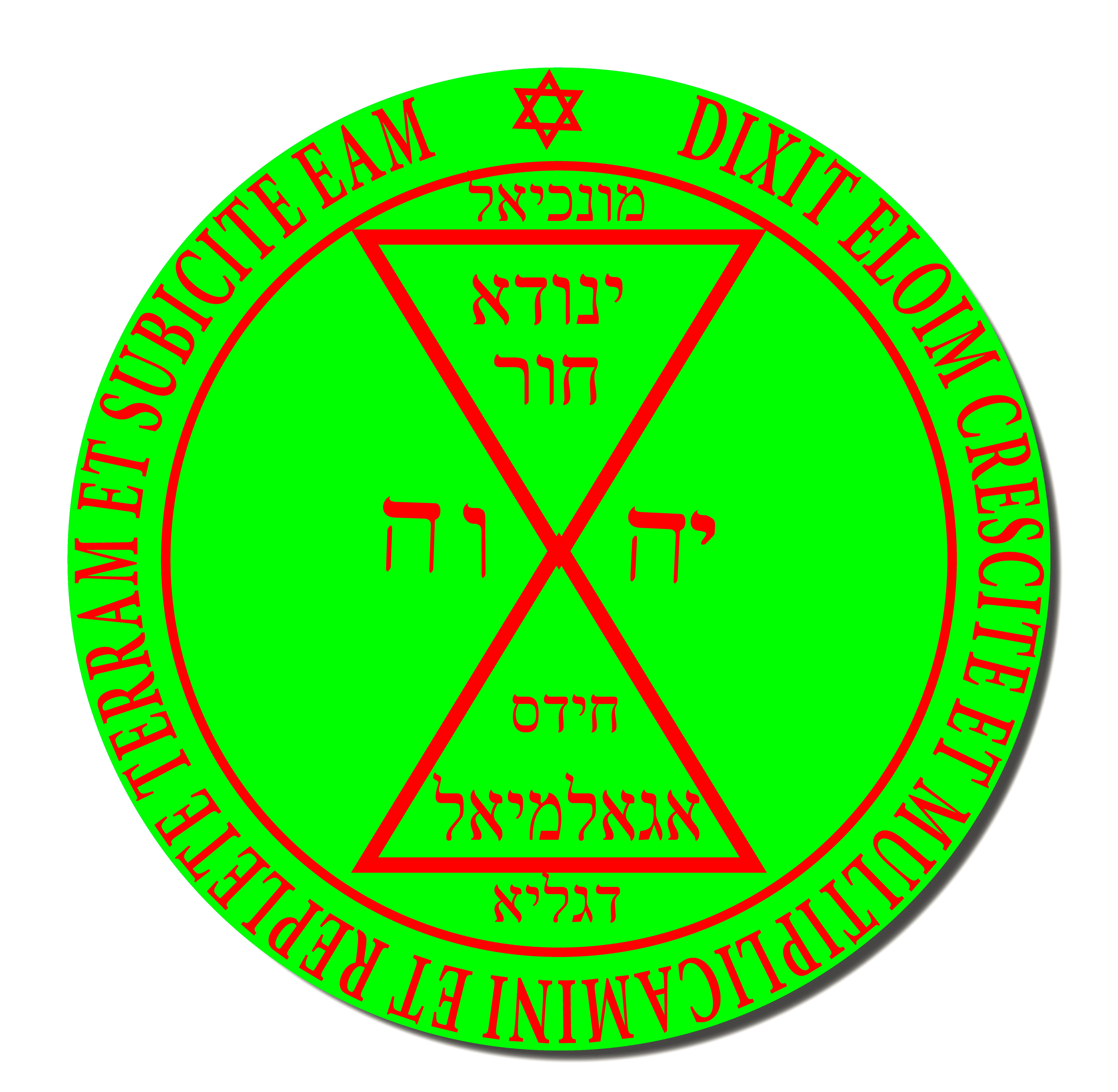
Third Pentacle of Venus
Attracting Love

The Third Pentacle of Venus is one of those seals which makes a lot of cash for fake talisman makers on the Internet. Like many of the promised effects attached to Key of Solomon seals, this one should not be read in the simplistic way modern sellers present it. If your average incel tried to use this seal to obtain the love of a girl onto whom he could project his misogynist fantasies, he would be disappointed.
This myth is not helped by Mathers’ statement that the pentacle, when shown to any person, “serves to attract love.” This sounds as if the operator just has to wave the pentacle before the desired person and affection will obediently follow, like a badly trained spaniel. But that is a modern literalisation of a much older magical instruction. In the Solomonic context, the pentacle is a consecrated vehicle of Venusian power, structured through divine names and scriptural force. To “show” it means to display or present it as a sign of magical authority within a magical operation. Mathers gives the result in deceptively simple English, but he does not spell out the ritual machinery that makes the result intelligible. The pentacle attracts love because it has been ritually empowered to draw affection, favour, receptivity and desire, not because the target has glanced at a piece of parchment and suddenly lost all free will, taste and common sense.
The phrase “attract love” is not as precise as it looks either. A modern reader is likely to understand it as romantic or sexual attraction directed at one chosen person. In an older Venusian magical context, love is not confined to private desire. It describes a condition in which feeling becomes warmer, reception becomes easier, hostility loses force, and the operator is surrounded by a more favourable emotional climate. The pentacle may be meant to create sympathy around the operation, not to turn the first person who sees it into a helpless admirer. Mathers’ wording encourages an overly literal reading, but the magical context points to something broader and less mechanical.
The key to the pentacle’s primary use appears to be the invocation of the angel Monachiel, whose name and history are problematic. The tempting pseudo-etymology is from Greek and Latin monachos or monachus, meaning “monk” or “solitary one.” That would give something like “monk of God” or “solitary one of God.” Forcing a Hebrew derivation, Monachiel could be read very tentatively as something like “the placed/resting one of God” or “that which is set down by God.” But that is speculative and probably too tidy. Angelic names in Solomonic manuscripts are often corrupt, badly transliterated, copied from damaged exemplars, or reshaped by scribes who did not understand the languages they were handling. Monachiel may be a manuscript corruption, not a transparent theological name.