
The Oracle in the Machine
Why computers can’t predict the future

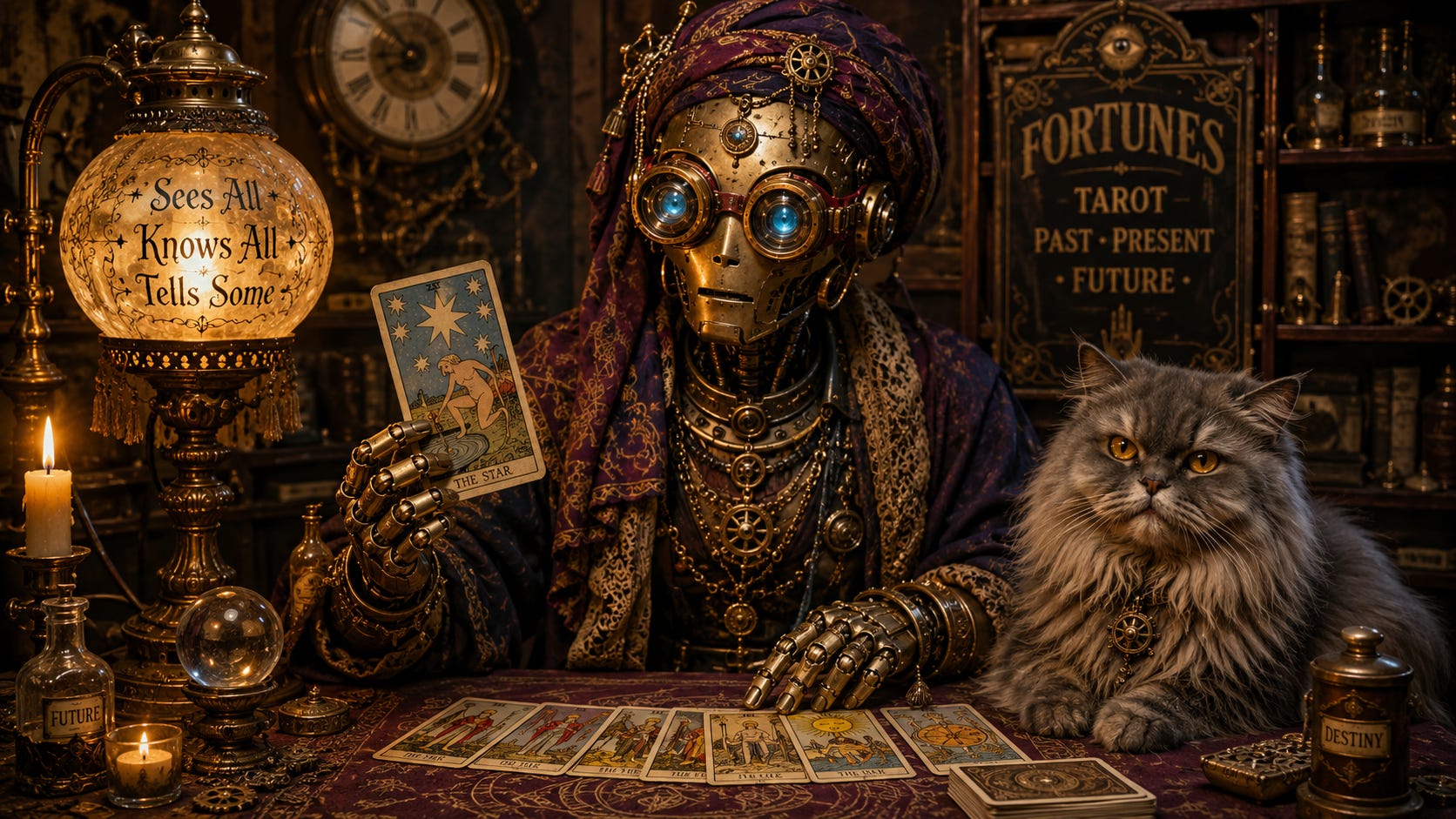
There are hundreds of sites that will do you a tarot reading, cast a geomantic chart, throw runes, generate an I Ching hexagram or pretend to consult the unseen while a server somewhere in California guzzles electricity. Press a button and a server coughs up an “oracle”: no shuffling, no ceremony, no time to wonder whether the unseen are side-eyeing your life choices. It is divination as a takeaway.
Some of these tools are useful. A programme that calculates a geomantic chart after you have generated the mothers yourself is doing arithmetic, and a site that lists the basic meaning of a tarot card works like a reference book that will not fall off the shelf and injure your cat.
Things get silly when the computer produces an oracle on your behalf and expects you to experience it as a life-changing event. It picks the cards, generates the figures, casts the runes, tidies the layout, and presents it as if the cosmos personally got back to you.
On paper, that ought to be fine. If you take the Jungian account that many occultists lean on, divination does not depend on ordinary causation, so a computer is not barred at the door by physics. Jung’s synchronicity offers language for a meaningful coincidence in which an inner state and an outer pattern arrive together, without any simple chain of cause and effect.
That is why Jung took the I Ching seriously. Coins and stalks are not clever, yet their fall can still speak because the pattern lands at a particular moment for a particular person holding a question in their mind and meaning arrives as a result. The coincidence is acausal, and it still carries weight.
If that is the mechanism, a computer looks like an easy substitute. A random number generator can stand in for coins, dice, shuffled cards or dots in sand, and a website can produce four geomantic mothers in less than a second while a tarot app spits out a Celtic Cross in a heartbeat.
Yet a lot of experienced diviners react to computer-made readings with a weary shrug. The spread looks plausible and the chart can be technically correct, but the divination arrives with the emotional authority of an auto-generated receipt. It does not bite in the way an oracle does when it feels as if something has answered rather than something has been delivered to you mechanically, quickly and through a machine.
Geomancy practically mocks you with how obvious this is. The mothers can be generated by code, or by a badly designed 1998 site that should be prosecuted for its background texture, and the maths will still oblige: figures tally, houses fill, judge appears. You get a chart. You rarely get an encounter.
Traditional methods change that because they make the operator do the choosing in a way that brings attention into the moment. Marks in sand, dots on paper, consecrated dice, coins and stones all demand a brief stretch of time in which the person directs their focus, invokes a higher force, aligns with that force, and brings breath and nerves into the act. That cannot be replaced by a machine.
I have grave doubts that ancient gods or muses talk to my computer, although I am prepared to admit that it has been possessed by a few demons in its time (but that might just be Microsoft). Nearly all the spirits you are likely to encounter for a divination are going to want some form of sacrifice, even if it is your time.
Modern life teaches people to treat the body as a carrier for opinions and caffeine, and magic corrects that assumption fast. The body is the instrument that steadies the question, registers tiny shifts in timing, and bears the awkwardness that makes the moment real enough to count.
Shuffling, cutting and laying cards slows the mind and holds it on the question. Casting or drawing creates a charged pause, because something is about to become fixed that was not fixed a moment before. The magician watches order form out of chaos, and that is part of the mystical experience. A click-to-reveal reading can feel thin because it removes the operator: the living, ensouled part that connects with the universe and brings the message down to earth.
If synchronicity gets defined as a “random result plus interpretation equals meaning”, then everything can be drafted as an oracle, from a shuffled playlist to a supermarket receipt to the first sentence on page 37 of a printer manual. Omen reading and bibliomancy have always allowed meaning to crawl out of odd corners, yet formal divination aims at something more exact than scavenging significance after the event.
A divinatory method gives you a repeatable way to reach a result, and repetition trains attention until slipping into the right state stops feeling like luck. The rite becomes the conditions in which the work happens, and the instrument becomes something hands recognise, marked by memory and habit.
This is where modern magicians get a bit moist about quantum mechanics as a replacement for synchronicity, because it sounds like choice-by-observation and features with a cat that is both dead and alive until someone opens a box. Schrödinger’s cat is a thought experiment about superposition and measurement, and occultists love it because it looks like a cosmic permission slip for saying “the act of looking makes it real”. So when they do a divination, they are observing a quantum field and making it happen. The cat is neither dead nor alive until the box is opened, at which point the universe has either produced a corpse or a furious animal with claws, teeth and grounds for litigation.
In physics, “observer” usually means measurement, an interaction within a physical system, which is why physicists wince when occult writing inflates it into consciousness, intention, spiritual awareness, positive thinking, or manifesting a parking space.
IStill, handled as metaphor, quantum measurement makes one useful point for divination: interaction narrows possibilities into a single outcome, and choices are baked into how that interaction is set up.
That is exactly how an occultist can use it without embarrassing everyone. A diviner sets up a way of interacting with uncertainty through a question and a practice, then performs an act that fixes one result out of many, then reads it in the language of a symbol system. The “choice” sits in the arrangement of the act and the commitment to it, not in wishing hard enough for the universe to behave.
Although a machine can randomise just fine, it cannot bring will or focus to the moment, and it cannot do the slow work by which a tool becomes part of a rite through use and care. A clean arrangement of symbols lacks the physical and spiritual connection needed for divination to make sense in a specific context.
A long-used tarot deck carries a particular feel in the hands, and the hands know when to stop shuffling long before the mind has produced a reason. A set of geomantic dice made, marked, prayed over and used in a steady context develops a kind of familiarity that is hard to fake. None of this requires laboratory proof to be obvious in practice, because the difference shows up in the quality of attention the instrument draws out of the operator.
Geomancy makes this clear, because it begins with an irrational bodily act. You scribble without counting, boil each line down to odd or even, and the system obediently locks into place. That first messy motion is the gate: it forces the chart to pass through you and into the moment, instead of arriving like a clean download.
In Tarot shuffling and cutting is a period of concentration in which the question settles into the hands, and the spread appears by degrees as the cards are placed rather than popping into existence fully formed. The reading begins before the first card is turned, because the mind has had time to enter the symbolic field while the body does the work.
Runes rely on the same logic. A piece drawn from a bag comes out of darkness into sight, and that descent carries mythic weight in a way a screen pop-up struggles to match. A digital rune can feel like a pop-up advert with mythic branding, even when the symbol is correct.
None of this means digital divination is completely useless. A skilled operator can read almost anything if the moment is framed properly. Some people can read clouds, traffic lights, overheard phrases or the behaviour of a pigeon and still draw something useful from it. A digital tool can become serviceable in those hands because the operator supplies the missing element: conscious interaction with the symbol.
However, this convenient alternative should never replace the main tool. A website can copy the layout, the symbols and the official meanings, then spit out an interpretation that sounds impressively confident, but those are only the parts you can screenshot. The rite includes the slow pressure of attention and time, performed in a way that allows the answer to become meaningful.
Synchronicity remains useful because it names meaning without pretending there’s a neat causal mechanism underneath. Quantum mechanics is useful only if you treat it like a metaphor and not a permission slip for ‘consciousness creates reality.’ The moral is boring but true: the oracle hits when someone actually does the work that makes the moment real and spiritually aligned.
The modern world keeps trying to remove friction from everything, which is why it produces so much spiritual polystyrene. Divination gains force in the pause and the physical bother of doing it properly and clicking for an instant result strips that out.
A computer can throw the dice for you, but it cannot make your hand tremble before they fall.
Paid subscribers can hear and download this article below the paywall
