
Roadmaps in Magic
No need for a GPS

I write for IT magazines, and we talk a lot about roadmaps. These are the plans that companies have for their product launches. Most of the time, they are good, but very often products drop off the roadmaps. Intel recently changed its legendary TikTok roadmap due to production difficulties. While these changes are a little embarrassing, no one cares that much. They move on to the next Roadmap.
If you look at the many magical and religious systems out there, they share many similarities with roadmaps; the only difference is that people get very precious about them.
In my life, I have followed lots of different roadmaps. Some of them have been dead ends, and others had taken me so far before I needed to find something else. I started following the Evangelical Christian Roadmap until I realised that its attitude to sex and hate was not my thing. Then I followed the Builders of the Adytum roadmap until I could not cope with the New Age flavour of it all.
Next, I joined the Servants of the Light and was happy with that Roadmap, but felt it was too personality-oriented (with a little too much fantasy for my liking). I joined the Golden Dawn and followed its Roadmap for most of my life. I chose it because I saw the need for a better structure, as these things had been lacking in other elements of my path. I put it aside partly because I was bored with it, and dealing with many of the people who used it. It was someone else’s map, and it had its use getting me to a certain point, but I wanted a crack at making my own. Although I am knowledgeable about that map, because I have been using it for so long, some of its features have ended up in my new map.
A Roadmap is just a guide
Roadmaps are only guides, and some of them depend on the reader to have any value. Some are good, and others are as accurate as Apple Maps. Others are good at pointing you in a general direction; others get bogged down in so much detail you can’t see the wood for the trees.
The territory does not change, but the roadmaps vary considerably. I suspect this is to ensure everyone experiences the one thing.
A person adopts a roadmap and follows its symbols. There are no bespoke roadmaps, so a person takes one and adapts it. Using someone else’s map means making changes in your worldview to adapt to it. It will work well for that person, provided the map explains the situations they find themselves in and the changes do not cause them to move too far from their unique perception of the world.
But if the roadmap does not work, or the map reader discovers holes, they start to make their notes on the map until it reaches a point that the person drops the map entirely. If they are suitably advanced on their spiritual path, they will start sketching out their map based on their existing knowledge and the material from different sources. If they get something from their map, they might pass it on (which is called teaching).
I had a row the other day with someone who insisted that their road map of the GD was better than mine. It was because it was his, and he had invested a lot of time in it, and he was the authority (at least of his map). But this ignored the fundamental law of roadmaps.
Golden Dawn roadmap
A Golden Dawn student is not given the roadmap until late in the system. In the middle of an initiation, they are shown the grades and all the titles associated with them, or the division of the system into three orders. These are placed on the Tree of Life, and if the student has not understood them by that stage in their magical development, one must ask what they have been learning. But it is important because it acts as confirmation of their experience so far in the order. It is like one of those maps you get on a hiking trail showing you the car park, the route and a helpful “you are here” arrow. This gives you the chance to double back or carry on.
When a Golden Dawn student is shown the full Tree of Life diagram with the grades mapped onto it, it feels like confirmation. The experience so far suddenly “makes sense.” The rituals line up, symbolism aligns, and the journey appears structured. There is an unconscious relief in that. This is called narrative coherence and is when disparate experiences are arranged into a pattern that feels meaningful and organised. Humans crave it because it stabilises identity and quiets anxiety, giving the past a sense of meaning.
So, when the student sees the diagram, they might think:
“Ah. I was in Yesod. Now I understand why that felt lunar.”
“Of course, that crisis was Netzach.”
“Now I see the ascent.”
But the diagram provides a retroactive interpretive grid that allows the student to reinterpret their experiences to fit the system.
Experiencing confirmation doesn’t necessarily indicate metaphysical truth; but it could reflect how well our thinking matches up. The strength of the system may come from its capacity to bring order to our inner chaos through structured meaning. In this sense, the Tree functions less as a precise guide and more as a generator of stories.
A Roadmap is not the territory
If you cannot understand the territory you are in, you are lost. So, while a roadmap appears to provide answers, there is no guarantee it is of any use unless you can use it to identify a landmark. Systems are only as good as the spiritual awakening they are supposed to provide. If you are not changing, not getting anything, it does not matter whether your roadmap came to you from Samuel Mathers or Felkin, as long as it has lots of stamps guaranteeing its authority.
Maps get old
Even if the map is good, it will always need to be updated. If you believe that when it comes to magical systems, “the older is, the better,” have a look at an Ancient Roman or Medieval Map. Even when the territory is marked accurately, the associated knowledge is often way off. You can see people with one foot, or their mouths in their stomachs, and at the time, people believed it to be true.
Victorian maps had everything coloured red-pink, and there were loads of differently named counties we don’t see today.
At some point, even the good maps need to be updated. Some of the features which they identified were still there, but others must go.
Roadmaps and magic
If your map includes the possibility of magic, then magic should be part of your life and will work for you as long as you follow the rules that came with your map. But if your map does not allow for magic to exist, then it will not work for you. For example, if you join a school which teaches a particular flavour of magic, but at the same time you do not bend your unconsciousness to follow it, the magic will not work, and you will go nowhere. If you invoke change in your life, while at the same time your Roadmap forbids you from changing, you are going to remain unchanged. It would be best if you changed your roadmap (accept that of the school you have joined).
A roadmap is not just a set of teachings; it is a set of conscious and unconscious permissions and prohibitions, the lenses through which you perceive and understand the world and connected to your awareness level at that time in your life. If your Evangelical Roadmap says sex is shameful, then every magical current that rises through the body will be filtered through guilt. If your New Age roadmap says “everything is love and light,” then your shadow work will be suffocated. If your Golden Dawn roadmap treats grade as a measure of progress, you might mistake ceremonial skill for transformation, and it will catch you out in the end.
A magical or religious system influences how you perceive and interpret your experiences, gradually shaping your emotions, expectations, fears, and beliefs about what is possible.
The “territory” refers to core human experiences like consciousness, desire, fear, mortality, the encounter with mystery. That remains constant. What changes is the interpretive structure placed over it.
An Evangelical Christian perspective organises experience around sin, salvation, obedience, and judgement. Sexual urges may be seen as temptation and doubt as spiritual failure. The same psychological experiences are interpreted through a moral lens, creating feelings of guilt and watchfulness.
New Age frameworks can shift the mood by labelling anger as “low vibration” and reframing conflict as “a lesson.” Negative feelings are often suppressed for positivity, guiding the mind to interpret experiences in harmonious terms. Though nothing around us changes, the atmosphere becomes softened or evasive.
A Golden Dawn-style ceremony shapes a climate of structured progress, symbolic grades, and ritual practice. Authority is based on historical lineage, and experiences are interpreted through Kabbalistic connections instead of moral judgement, creating an architectural, hierarchical internal atmosphere.
Inner experiences, such as fear or insight, take on different meanings depending on the system used to interpret them, and that shift changes feeling and response.
Systems play a crucial role because they establish expectations that ultimately affect how we perceive things. Our perception, in turn, influences our actions. In this way, a roadmap doesn’t simply direct someone through an area but shapes what travellers think they observe along their journey.
Ironically, those who claim that their version of the Golden Dawn or Wicca is completely correct are like two meteorologists insisting their forecast defines the sky. When people defend their system aggressively, they are defending the internal coherence it provides them. If the map is changed and the psychological weather shifts, the student can be destabilised.
In the end, every magical roadmap is only a support that helps you ascend; it is never the destination. If a system widens your perspective and deepens your awareness to the point that it changes you, then it has done its work; but if you defend the system more fiercely than your own growth, you’re confusing the model for reality. A map is useful while it guides your progress; once it starts replacing your actual journey, it loses value and turns into another attachment.
This is great. I too have found myself following several different roadmaps, and what a great reminder to not let these systems replace the actual journey.
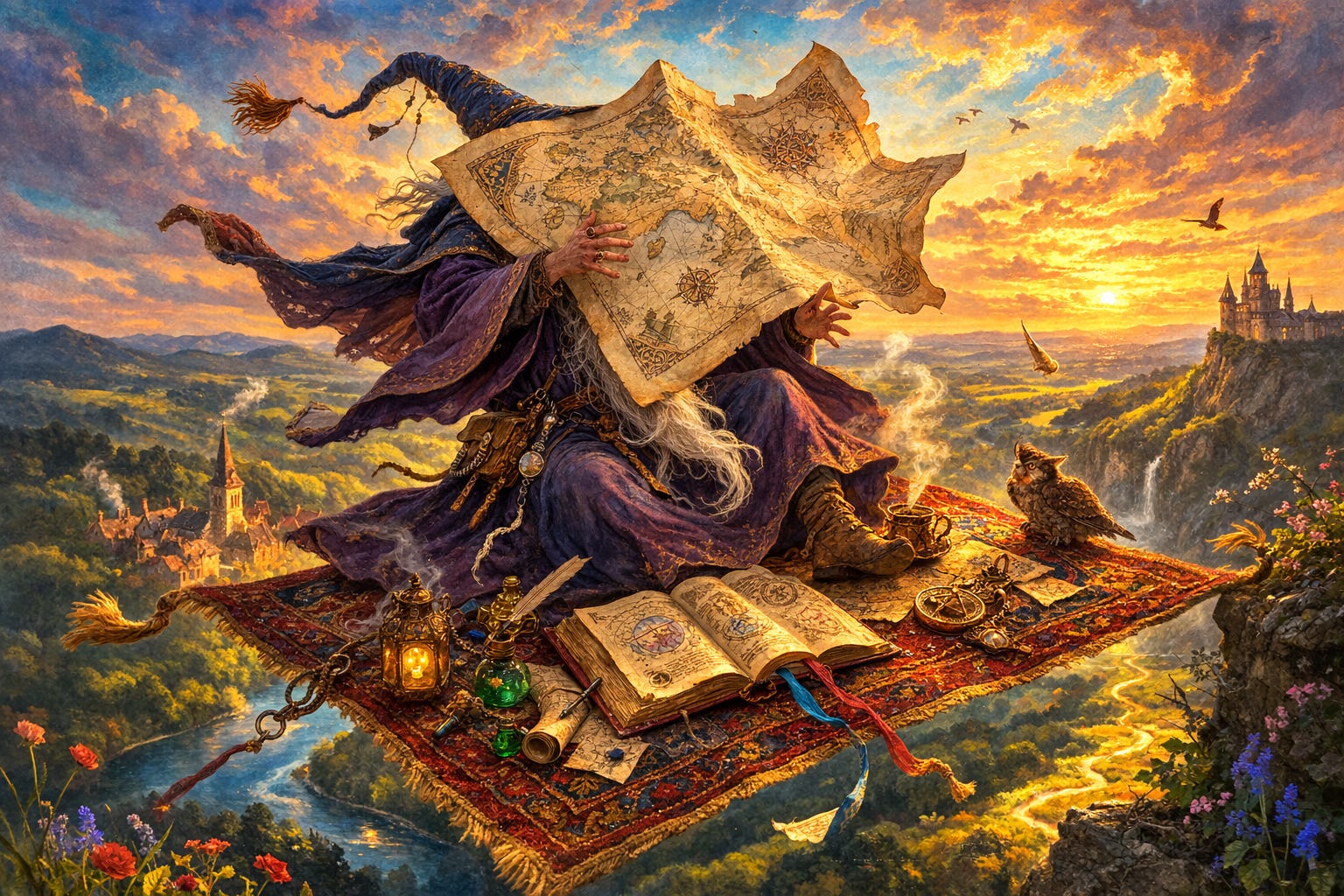
The Map is not the territory - I love the image used, it shows the map can get in the way of the real.