
Power Before Enlightenment

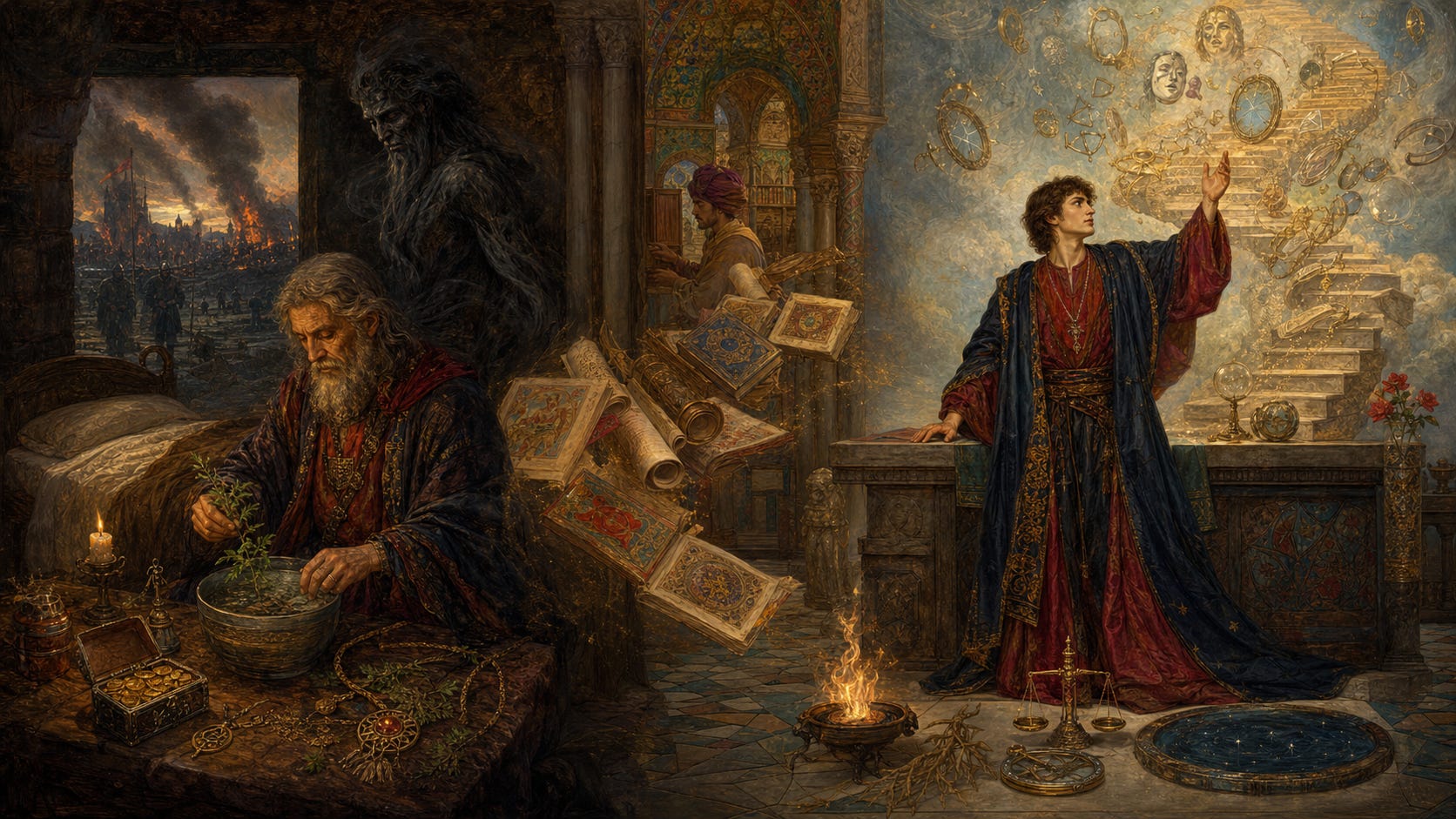
Occult literature begins to change noticeably around the seventeenth century, when translations and reports from the East entered European languages and brought Enlightenment ideas that had previously sat on the margins of Western magic.
The change altered what the magician thought magic was for.
In the Greek Magical Papyri, one of the most frequently cited sources on magic in antiquity, we find numerous practices of a completely pragmatic nature. The goal of the ancient magician was to obtain power, whether through initiatory processes such as the Mithraic Liturgy or through various spirit companions, or paredroi, who would provide guidance, protection, and a variety of services.
The objective of contacting a higher divinity was to obtain power that would allow the magician to survive an era in which wars were common, governments were often tyrannical, and access to healthcare was limited to the wealthy and constrained by the medical knowledge of the time. In short, survival was a full-time occupation.
Conditions we now discuss under names such as depression, trauma or neurodiversity were not understood through modern categories. They could simply make life harder, stranger or shorter.
Likewise, in a world where modern science did not exist and much was shrouded in mystery, the collective human consciousness was probably less resistant to miracles and magic, allowing what today would be considered a mediocre magician to reach levels that might have seemed far superior to the norm of the time.
If we look at the content of the PGM and medieval grimoires, obtaining wealth, curing diseases, influencing the powerful, and getting sex were the norm, with only superficial mentions of the liberal arts, which subtly represented the desire for personal and internal development.
As early as the 17th and 18th centuries, the first translations of Indian philosophy began to appear in the West. Here, the concept of enlightenment emerged, at least for many Western readers, as the central axis of Eastern mysticism, a goal that goes beyond mere survival and implies a conscious unification with the universe. This was already present in medieval texts such as the Book of Abramelin, though obscured by layers of practical applications that made it a desirable outcome only if you survived the world, thanks to the countless contributions the technique offered when well executed.
From the 17th century until now, the concept of enlightenment has been gaining weight, largely thanks to the highly imaginative and often dubious narratives of Madame Blavatsky, who used them effectively to survive what, without much effort to analyse, looks like a survival mechanism. After all, she was a teenager married to a man more than twice her age, belonging to what we might call a “provincial nobility”, who married her because she was young and came from a family with minor connections to the Russian nobility. In short, he treated her like cattle, and it would not be surprising if her family had sweetened the arrangement to ensure that the vice governor saw her as a good match, since she herself was not considered an attractive woman. But she ran away and needed to maintain a lifestyle that met her expectations, so telling mystical stories about her travels made her a favourite curiosity among wealthy patrons, a kind of Scheherazade of Indianised occult tales, which eventually grew into the Theosophical Society.
With Blavatsky and her Theosophy, enlightenment, spiritual ascent, and spiritual hierarchies became increasingly important and desirable themes, a development that spanned from the 19th to the 20th century, when they were consolidated, and that in the 21st century has made them unavoidable themes in occultism.
Older magic was built around survival, power and practical intervention. Later Western occultism absorbed mystical ideals of enlightenment and spiritual ascent, often through Theosophy and half-digested Eastern material. The modern magician has to recover power as lucid agency: the disciplined ability to read the forces shaping a situation, act from the least deluded part of the self, and loosen the bonds that keep consciousness trapped.
Occultism with aspirations to enlightenment stumbles at the same point as all of Madame Blavatsky’s fantasies: its lack of consistency with the real world. Blavatsky’s stories about root races are biologically indefensible and remarkably racist, with a notable contempt for anything that was not “white and Aryan.” The inconsistency in the concept of enlightenment as understood in the West has proven even more persistent.
Originally, Indian philosophy often presents enlightenment as a distant ideal to be attained over many lifetimes, something you work towards spiritually throughout your entire life, even knowing that you will likely never reach it. It is like laying the bricks today for a house you will inhabit in many future lives. But when this philosophy was brought to the West, it gained a sense of immediacy. If you follow its premises, it should be achievable in a single lifetime; that is how the idea is sold to Westerners.
Today, enlightenment and liberation from karma through mystical methods of dubious origin are products for sale, a clear symptom of the degeneration of Western spirituality.
This Westernised vision turns the spiritual quest into escapism. Incapable of facing life or bearing their own karma, the new mystics are simply looking for a quick way to get rid of everything and ascend to a plane where, according to a poorly founded theory with holes big enough for a space shuttle to pass through, they will not experience suffering. They have not reached a higher state through merit; they have hacked the system, like someone obtaining a university degree without ever setting foot in a classroom, having merely bribed the right person for a certificate to frame.
The worst aspect of this trend is its profound disdain for the material world, considering the physical world as something inherently evil, something that is often fostered by partial and incomplete interpretations of the Gnostic texts of the early centuries of this era, which are mixed chaotically and with vested interests alongside Eastern ideas, while despising money, sex, and any emotional bond.
A magician should not take refuge in a convenient escape from the material world, nor despise matter or the ordinary conditions of embodied life, since these are the fields in which consciousness is tested. Nor should enlightenment be treated as an immediate prize, as if the soul could jump the queue by learning some tricks.
A magician seeks power as a disciplined agency within a world shaped by unseen forces, destiny, appetite and fear. That power grows through perception and intelligent action. Learning not to be passive or naïve about the surrounding universe should not make the practitioner ignorant and arrogant.
Power works through steady change: understanding influences, distinguishing divine prompting from fear, and regaining the freedom to act differently.
Power usually arrives through a non-egoic delivery system: work with something larger than the personality, toward ends that neither masturbate the ego nor overinflate the magical self-image.
A magician who claims spiritual ascent while remaining governed by resentment, panic, vanity, or unconscious desire has not transcended the world and cannot get their head around what magic is all about. While they are desperately invoking Venus to get a girlfriend, they are never going to understand what her force really represents.
The aim is lucid participation in the cosmos, acting from balance, and restoring agency within the conditions of the soul's existence.
Liberation also has to be understood pragmatically. A magician can be imprisoned by a historical worldview taken so literally that new ideas cannot flower. A system that once carried power can become a museum cabinet if its symbols are preserved without living contact. The One Thing is approached through the universe as it stands now, not through a worldview that was already ripe in the nineteenth century and has since begun to smell.
Another shackle is the desperate attempt to appear publicly as a magician. Social media is full of people with limited experience trying to dominate every discussion so they can appear authoritative. The chain binds them as tightly as it misleads the idiots who follow them. Once someone builds an identity around “look at me,” they become dependent on an image they cannot sustain. Their followers will eventually be disappointed. The magician will eventually be trapped by the mask.
The same concept applies inwardly. Each magician holds their own inner vision of power, which is seldom without bias. This idea may be shaped by fear, revenge, humiliation, ambition, inherited beliefs, or even a childlike desire to escape normal boundaries. If this image goes unexamined, the magician could spend years summoning spirits to heal unresolved issues while mistaking that experience for spiritual growth.
Exercise
For this last point, I propose an exercise of a dialectical nature: write your definition of “power” on a piece of paper. You must write it down. Then examine the words you have chosen. Analyse their implications, their background, and even their etymology. Search your memory for the contexts in which each word was used, including the beneficial or harmful associations you attached to it.
Ask whether your definition of power belongs to your fear, wound, ambition, or some inherited moral suspicion of strength. From there, revise the definition until power means conscious agency: the capacity to act from the part of the self least governed by illusion.
Nick Farrell reads out this story for paid subscribers below

 |
|