
Bad Gnosticism vs Real Gnosticism
A response to lazy critiques

There is something almost impressive about the journey from misunderstanding to manifesto in contemporary esoteric writing. What frustrates me is not disagreement; that is perfectly acceptable. It is watching people misread complex traditions, mistake that confusion for the whole tradition, and then issue cosmic verdicts.
I was genuinely surprised by this article. Although I understand the criticism of the modern internet parody of Gnosticism, a more intellectually honest approach to what real Gnosticism is, would be far better. That would mean not just presenting the distorted version, but distinguishing it from the actual traditions, rather than leading the reader to think that a prosaic description is sufficient. There is a clear confusion here between internet paranoia and real Gnostic myth, which is why people end up throwing the baby out with the bathwater.
The universe will always exceed the language used to describe it. Millennia of myth, symbolism, cosmology, metaphysics and philosophy exist because ordinary speech cannot grasp reality directly. It can only filter it through human perception, turning the immeasurable into something small enough to be argued over. For me, the problem starts when someone says the cosmos is this and not that. This rules out Socrates and his inconvenient awareness that he knew practically nothing.
Plato and Jung are more useful here than another sermon from the Church of Cosmic Reassurance. Plato knew that myth could approach truths that ordinary argument cannot fully contain. Jung saw myth as a living structure of the psyche. Saying “the world is Divine play” is not automatically more spiritually mature than saying “the world is a prison.” Both are mythic models; they reveal and conceal something at the same time. Either can become reductive when treated as final. To claim that one myth is truer because it offers a gentler cosmodicy is emotional relief, and not much else.
A first problem is that the author seems to mention only Sethian Gnosticism, when the complexity of Gnostic texts goes far beyond that, with different and sometimes conflicting philosophies within the material itself. There is a rich bibliography of authors still trying to classify a term that remains contested. Rejecting a so-called dualistic or pessimistic view of the cosmos, without understanding it fully, only to replace it with a non-dual, ecstatic and more consoling one, does not resolve anything. The internet version of Gnosticism, with “loosh harvesting,” cosmic farm managers, and archons behaving like vampires, is usually a ridiculous modern cartoon. It reduces ancient myth to conspiracy folklore, which is insulting, especially from those who should know better.
For those unfamiliar with the term, “loosh” was coined by Robert Monroe and appears in Far Journeys, published in 1985. It refers to energy generated by organic life, with its most valued form linked to human emotional experience. The internet has since turned this into a theory of human suffering harvested by higher entities. Its credentials as ancient Gnosticism are weakened slightly by the embarrassing fact that ancient Gnostics never seem to mention it.
Ancient Gnostic material is serious and extremely complex. Anyone who has read Sethian or Valentinian texts, the Pistis Sophia, the Books of Jeu, alongside Hermetic, Platonic, and Qabalistic sources knows that the traditions do not condense into one neat metaphysical slogan; that would be spiritual reductionism. In the author’s replacement model, ego becomes Ahamkara rather than part of an Archontic structure. Maya becomes hide-and-seek. The Demiurge becomes psychologically irrelevant. Again, the map is not the territory.
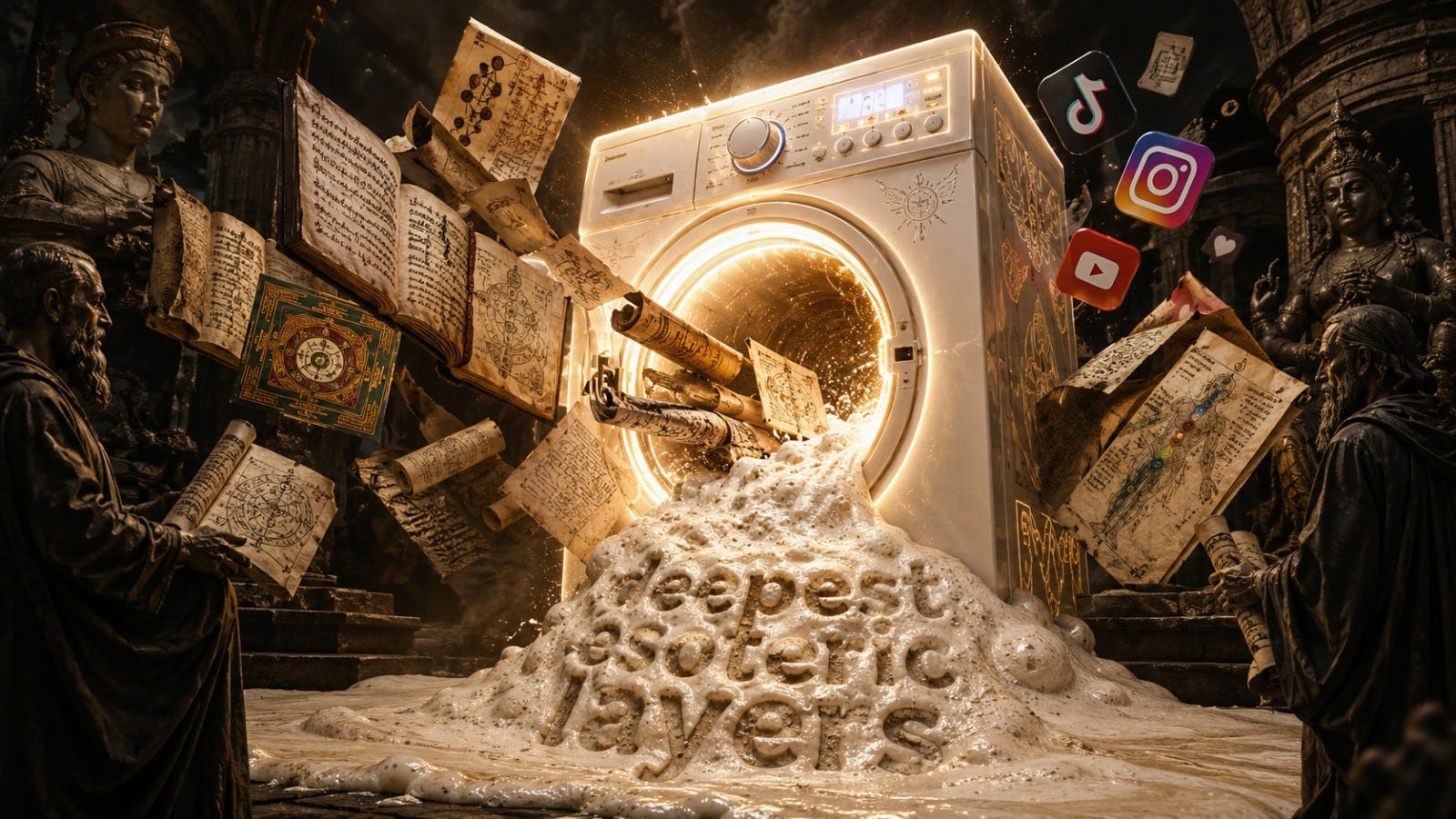
A sharper critique would distinguish these traditions from modern conspiracy material, non-dual Tantric metaphysics, and Qabalistic magical psychology. Instead, the article throws them into a large spiritual washing machine and decides that the resulting foam is “the deepest esoteric layers of understanding.”
Some statements can be seen as a valid mystical reading, but the article misses the most interesting possibility. The Archons do not have to be pictured as cartoon jailers feeding on misery. They can be understood as bureaucratic forces of limit, order, and repetition. In that sense, they are necessary. Without boundaries, there is no world, body, time, individuality, or life as we know it. Without structure, particles do not become a cosmos, they remain an unorganised field, lacking the stable relations needed for atoms and life.
But necessity does not make these forces benevolent. A cell wall and a womb both contain. Saturn gives form and also crushes. What seems like a natural outflow from the source can turn into lower layers that trap consciousness inside their own self-maintaining patterns.
The world of becoming is not identical with the intelligible model. It receives order, but it introduces instability and limitation. In Neoplatonism, the sensible world proceeds from higher principles, yet its distance from the One has consequences. The further supernal force descends, the more it appears with diminished unity and less direct participation in intelligible order. This does not require an evil second god. Mediation and privation are enough to do the damage, and they create the conditions that Gnostic myth can describe as archontic.
Hermeticism is also more complicated than the usual “As above, so below,” dragged into these discussions as if it makes complexity disappear. Correspondence does not give the universe an automatic harmony. Planetary forces may link the soul to cosmic order and simultaneously bind it into fate. The Hermetic ascent through the spheres exists because the embodied condition is not already free. If the cosmos were a beautiful reflective mirror, there would be no need to strip off the planetary attachments on the way upward.
Narcissus was killed by fascination. The image was real as a reflection, but it became fatal when he mistook mediated appearance for living reality. I talked about the reasons and mechanisms behind these correspondences in the Body of Fate part one and two. I spoke about the origin of Gnosticism and how and why it developed in a specific direction in Gnostic roots where I mentioned the traditions that already had an intuition of how the cosmos worked. Gnosticism did not appear fully formed out of nowhere and did not make an appearance when The Matrix was released. It developed from older religious, philosophical and cosmological currents, then took distinctive forms in late antiquity.
In Qabalah, emanation begins in divinity, but descent does not guarantee clean transmission. Matter is not in direct contact with the divine in the same way as the higher orders are; it receives spiritual outpouring through a cascade of mediation, and each level introduces further limitation. In Lurianic language, the breaking of the vessels gives rise to kelipot, (qliphoth, the “shells” or “husks”) that conceal holiness and trap sparks of divine light. The Sitra Achra, the Other Side, names the realm or condition in which this concealment becomes opposed to holiness.
So the qliphoth express an ontological problem within the created order, that eternal light can be distorted and held inside forms that no longer reveal their source. By the time divine force reaches the densest layers, it is no longer experienced as freedom. Something that originates in the divine can become dangerous through distortion, imbalance or automatic repetition. If all things come from the One, then corruption has to be explained within manifestation. The “Divine play” example risks becoming a spiritual anaesthetic, because the lower world may be divine expression at a degraded resolution, filtered through layers that no longer know what they are transmitting.
The author says the ego is “a deliberate, mathematically beautiful limitation taken on by the Divine.” Beautiful to whom? A limitation can be elegant from above and crippling from inside. A cancer cell is also a pattern. The fact that something participates in order does not make it spiritually benign. Order is not the same as wisdom or liberation.
I understand that people crave meaning to their suffering. Nietzsche argued that human beings can endure suffering more easily than meaninglessness. But the fact that a myth makes pain bearable does not make that myth universally true. It only explains why the person clings to it. Seeing the universe as a false order or a machinery of fate may be equally valid from another depth of experience. None of these models can be proven as final, and a personal cosmological reading is one possible interpretation, not the structure of the universe itself.
There is a moral danger in rushing too quickly to non-duality. The article wisely warns against spiritual bypassing, but its own metaphysics keeps drifting toward it. If the murderer, victim, saint, disease, archangel and child dying of cancer are all Divine play, then the system must work extremely hard to avoid sounding monstrous. Compassion is invoked as the answer, but compassion does not erase the metaphysical problem. It only proves that human beings often behave better than their cosmologies.
Gnosticism does not always explain pain in a way we like, but it refuses to put a patch on it. There is a savage honesty in saying that something is wrong with the world. The author says: “The Divine is currently experiencing deep, visceral trauma through localized human nervous systems, and we must feel it and fully digest it, that we may liberate it.”
There is a truth in that, but only if it is handled with care. Pain in my life became a great opportunity, and I used it wisely as a doorway to gnosis. I was privileged enough to survive my pain, interpret it, and turn it into knowledge. I was not born into famine or a war zone. I was not raped as a child, bombed at five, or forced to spend my early life with survival eating every scrap of consciousness. My suffering was real, but I had enough shelter around it to make meaning from it. That is not available to everyone. Compared with the horrifying realities endured by many people, and compared with those who, for countless reasons, cannot evolve through their pain, it would be excessive to turn suffering itself into a spiritual ornament. Not every painful experience is a chance for awakening, and not every wound is a blessing or becomes useful because a metaphysics finds a graceful description for it.
Not every repeated cycle is a school. If it were, cycles would not need to repeat with such brutal stupidity. The cycle of death and rebirth is not the soul gym some modern spiritual writers imagine, and reincarnation is not an entertaining detour. Even in Hindu traditions, saṃsāra is the cycle from which moksha seeks release. In Buddhism, rebirth is bound to ignorance, craving and the continuing round of suffering, and nirvana is liberation from that cycle. The Bardo Thödol presents the passage between death and rebirth as a perilous intermediate state in which liberation is possible, but so is renewed entanglement. If major traditions that teach rebirth also seek release from it, then perhaps we should hesitate before turning cosmic recurrence into a cheerful curriculum for the soul.
Gnostic material is not an “evil matter” caricature, nor a Satanic mistake stitched together by a cosmic idiot. M. David Litwa has masterfully articulated the concept of Gnosticism, and I have included his formulation in this article. Anyone still determined to turn that material into a bumper sticker should look at Justin Sledge’s discussion of the untitled text in the Bruce Codex, because apparently complexity requires a recognised YouTube academic before people stop flattening it. The text is so difficult and obscure that even scholars struggle to decide how best to classify and interpret it. That alone should make us cautious. Gnosticism is a serious and varied body of myth, theology, ritual and metaphysics rooted in late antiquity, with older philosophical and religious currents behind it, and it deserves better than being flattened into “prison planet pessimism” or internet conspiracy material.
A person may reject parts of Sethian myth, find its dualism excessive, or prefer Hermetic optimism or Tantric non-duality. But the closing claim that the universe is not a prison designed to harvest suffering, but a beautifully constructed, agonising, ecstatic playground, simply reverses the excess it criticises. It moves from a captivity-world myth that is too sinister to a cosmic-playground myth that is too romantic.
The author writes: “And what is hidden within that sacred heart, pulsing beneath the agonising friction of the material world? It is the permeation of an eternal, everlasting Love that grounds the entire Lila. It is a unifying force so absolute that it holds the entire bloody, beautiful simulation together.”
Līlā is bound to Māyā, concealment, karma and bondage. The play involves real forgetfulness, and consciousness becomes entangled in the conditions through which it appears. That is why liberation is needed. If the world were only an ecstatic display, there would be nothing to awaken from. The author’s own phrase, “bloody, beautiful simulation,” gives away the problem. Simulation implies a mediated field governed by rules and internal necessity. It is the kind of world in which consciousness can mistake the pattern for reality. That is not far from Gnostic concern; it is the same wound expressed through another metaphysical language.
Ancient Gnostic cosmology cannot be reduced to psychological fear. It drew from Jewish apocalypticism, Platonism, Christianity, Egyptian religion and Hermetic currents. People such as April DeConick, Erin Evans, M. David Litwa, Einar Thomassen, Michael Allen Williams and Karen King, among many others, have spent serious scholarly lives untangling this material. Treating it as a simplistic internet panic about archons is not an argument. The ancient world gave us multiple maps because reality is not obedient to one mood. A mature occultist does not need to flatten these maps into one agreeable postulate. The contradictions are part of the teaching.
The most intelligent position is neither sentimental optimism nor cosmic paranoia. The lower world may be necessary, ordered and divinely rooted. It may also be damaged, repetitive, restrictive and hostile to awakening. Most importantly, no single myth should be allowed to bully the others or declare itself the Truth.
I understand the desire to debunk a myth, especially when it has been degraded by online rubbish, but we must not confuse the rubbish with the tradition itself. Modern social media platforms have damaged esoteric traditions by turning them into spiritual junk food. The internet has done to Gnosticism what it does to everything else: trivialised it and then acted surprised when the result looked ridiculous. But this is why the argument needs more care. If the article is aiming at TikTok loosh harvesting fantasies and conspiracy-flavoured Demiurge material, then it should say so clearly. These are not serious representations of Gnosticism. They are modern distortions and refuting them is not the same as engaging with the actual tradition.
The closing claim of “we are not sinners in the hands of an angry Demiurge” is equally confusing. I am still waiting to find the Gnostic text in which human beings are treated as sinners in the born-again Christian or Catholic sense. Real Gnosticism is almost as far from that framework as one can get. Its problem is not inherited guilt before an offended moral deity; the human condition is not usually framed through original sin, but through ignorance, forgetfulness and material entanglement.
There is no childish polarity of an “evil universe” versus a “perfect universe despite suffering.” The cosmos does not become spiritually safe simply because it ultimately derives from the One.
The “Mordor” argument is a little silly. A cage for consciousness would not need to announce itself with black towers and bad weather. That is a child’s idea of imprisonment. The more effective confinement is imitation. I often use Plato’s cave as an example, and it is a more suitable model than Mordor. The genius of the cave is that the shadows do not look like a prison; they look like life.
In Gnostic terms, the danger is not always obvious oppression, but counterfeit order, distraction, fascination, habit and psychic sedation. Most human beings do not need Archons shrieking at them from basalt towers. They live and die inside inherited desires, social roles, compulsive behaviour, fear of loss, bodily necessity and the ordinary trance of survival, often with no developed concept of their divine origin at all. Extreme emotion may sometimes break the rational mind open, and the Vijñāna Bhairava Tantra does include practices in which fear or intense feeling can become openings into awareness. But that is a specialised method, not a general law. The Bhagavad Gītā is more cautious and warns that attachment leads to desire, anger, delusion, and the loss of discernment.
Reducing the Demiurge to a psychological bogeyman is equally inadequate. Treating it as an ego-archetype may be useful in one register, but it becomes misleading when mistaken for the whole picture. Limitation is not just an inner drama but lives in the body, instinct, inherited trauma, planetary cycles and death.
The Demiurge is not necessarily a literal lion-headed serpent with management issues. It can be the lower system’s intelligence or pseudo-intelligence that organises reality mechanically without possessing full knowledge of its source.
The writer who says non-dual awareness makes the Demiurge irrelevant has solved the problem only from the penthouse suite of his preferred spiritual system. If everything simply drifted back into God on its own, mystery traditions would not have bothered inventing all those exhausting practices, initiations and ordeals.
The evidence should be hard to miss by now: we would presumably see more than the usual historical parade of war, craving, violence and forgetfulness with better technology. We would see matter becoming more transparent to spirit, and awakening would be less of a miracle and more of a trend.
Beyond the Facebook Gnosticism, things should be analysed more carefully. Consciousness is trapped by structures that are both necessary and defective, divine in origin and obstructive in effect, and this cannot be dismissed by calling the universe a “a beautifully constructed, agonising, yet ecstatic playground designed to be experienced fully.”
If someone wishes to say, “My path reads the cosmos through non-dual Tantra, and from that height even the Demiurge becomes part of the Divine’s self-concealment,” that is a legitimate position. But it must remain a position. No one gets to solve the universe by choosing the myth that hurts less.
Paid subscribers can download or listen to this article below the paywall
